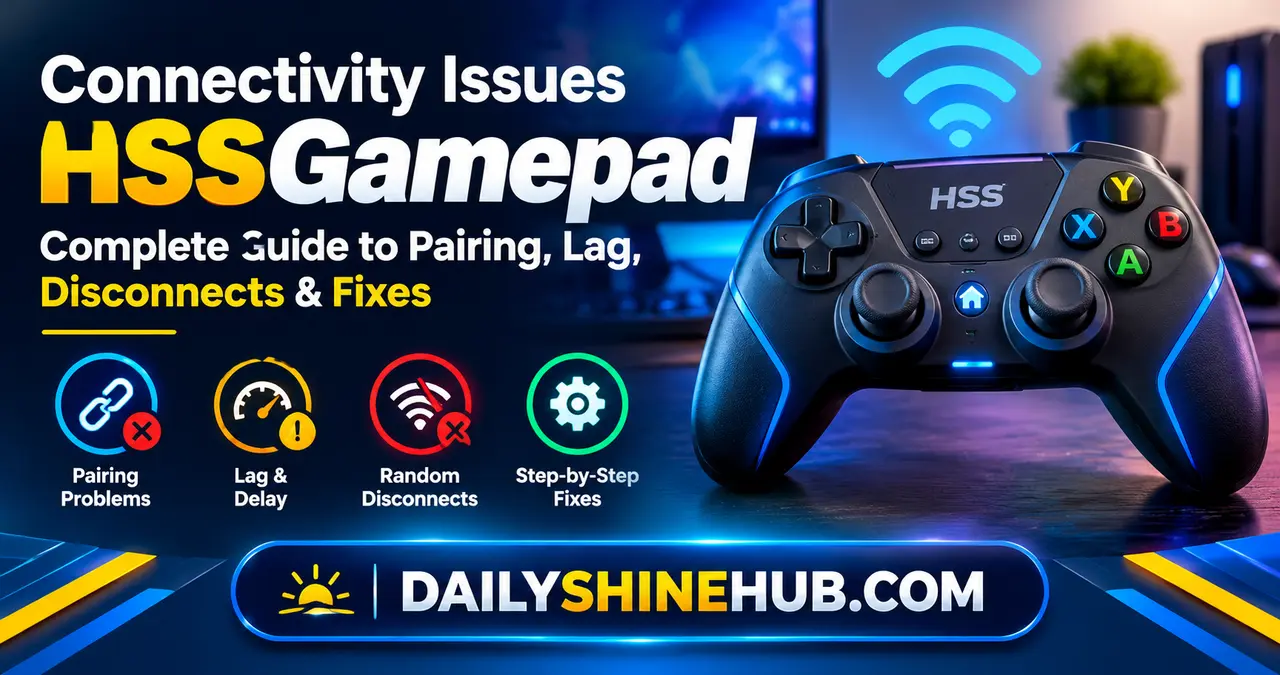
Connectivity issues HSSGamepad can quickly turn an enjoyable gaming session into a frustrating troubleshooting exercise. A controller may fail to appear in Bluetooth settings, connect successfully and then disconnect, respond with noticeable input delay, or work on one device while refusing to cooperate with another. These symptoms can have several causes, including low battery power, incorrect pairing mode, wireless interference, outdated software, USB problems, or compatibility settings.
Because publicly available information about specific HSSGamepad models can vary, the safest approach is to treat model-specific button combinations and features as dependent on the exact controller and its manual. The general troubleshooting principles below apply to Bluetooth, wired USB, and other common game-controller connection setups.
| Quick Detail | What to Check |
|---|---|
| Main problem | Controller connection, pairing, lag, or unexpected disconnection |
| Common connection methods | Bluetooth and USB; some models may support additional wireless methods |
| First check | Battery level and controller power |
| Wireless fix | Remove old pairing and pair again |
| Wired fix | Test another USB cable and port |
| PC fix | Check Bluetooth, Windows updates, drivers, and controller detection |
| Phone fix | Forget the controller and perform a fresh pairing |
| Interference check | Move away from congested wireless environments |
| Compatibility check | Confirm that the game supports the controller/input mode |
| Best diagnostic test | Try the controller on another compatible device |
What Causes Connectivity Issues HSSGamepad?
The first step toward fixing connectivity issues HSSGamepad is identifying what type of failure you are experiencing. A controller that never appears in a Bluetooth list requires a different approach from one that connects for ten minutes before dropping out.
Common causes include:
- Low or unstable battery power.
- The controller is not actually in pairing mode.
- An old Bluetooth connection is still stored on another device.
- Wireless interference is affecting communication.
- Bluetooth drivers or operating-system components need updating.
- A USB cable supports charging but not reliable data communication.
- A damaged or unreliable USB port is being used.
- The game does not properly support the controller.
- The controller is operating in an input mode the game does not recognize.
- Temporary Bluetooth or operating-system glitches are preventing communication.
Microsoft’s general Bluetooth guidance similarly recommends checking power, pairing mode, proximity, removing and re-adding problematic devices, installing updates, and restarting the computer when a Bluetooth device refuses to connect.
Connectivity Issues HSSGamepad: Start With the Simple Checks
Before changing drivers, resetting operating-system settings, or assuming that the controller is defective, perform a few basic checks. These steps resolve a surprising number of connectivity issues HSSGamepad without requiring advanced technical knowledge.
- Charge the controller: A low battery can prevent stable wireless operation.
- Power-cycle the controller: Turn it completely off, wait several seconds, and turn it back on.
- Check pairing mode: Make sure the controller is actively advertising itself for a new connection.
- Move closer to the device: Keep the controller reasonably close during initial pairing.
- Disconnect other devices: Temporarily reduce nearby Bluetooth connections.
- Restart the host device: Rebooting a phone, PC, or other compatible device can clear temporary connection problems.
- Check the game itself: Confirm that controller input is enabled and supported.
Microsoft also recommends testing a game controller independently from the game when possible, because separating a hardware/connection problem from a game-configuration problem makes troubleshooting much easier.
Connectivity Issues HSSGamepad and Bluetooth Pairing Problems
Bluetooth pairing is one of the most common areas where connectivity issues HSSGamepad become visible. The controller may be powered on but remain invisible, appear under an unexpected name, or show up in the Bluetooth list without successfully completing the connection.
A clean pairing process is often more effective than repeatedly pressing the connect button.
How to Re-Pair an HSSGamepad
Follow this sequence:
- Turn the controller off.
- Open Bluetooth settings on your phone or computer.
- Locate the previously saved controller entry.
- Select the option to forget, remove, or unpair the device.
- Turn the controller back on.
- Activate its pairing mode according to the model’s instructions.
- Keep the controller close to the host device.
- Search for new Bluetooth devices.
- Select the controller when it appears.
- Wait for the operating system to confirm the connection.
If the controller previously worked but suddenly stopped connecting, deleting the old pairing information is particularly useful. A fresh pairing forces the host device to establish a new Bluetooth relationship instead of relying on potentially corrupted or outdated connection information.
Connectivity Issues HSSGamepad Caused by Old Connections
A controller that has been used with several devices can sometimes create confusion during setup. For example, it may automatically attempt to reconnect to a previously paired phone, tablet, computer, or television.
Check the devices around you and:
- Disable Bluetooth temporarily on devices that are not being used.
- Forget the controller from old devices if necessary.
- Keep only the intended host device active during pairing.
- Restart Bluetooth before attempting a new connection.
This is especially helpful when a controller appears to be connected but does not respond to the device you actually want to use.
Connectivity Issues HSSGamepad Caused by Wireless Interference
Wireless communication does not happen in isolation. A crowded environment containing multiple Bluetooth accessories, wireless peripherals, routers, USB devices, and other radio sources can make a marginal connection less reliable.
Symptoms of interference may include:
- Random input delays.
- Short freezes during gameplay.
- Intermittent controller disconnects.
- Buttons responding inconsistently.
- A controller that works normally in one location but poorly in another.
Try moving closer to the host device while also reducing unnecessary wireless activity. If the controller improves immediately, environmental interference may have been contributing to the problem.
Microsoft specifically notes that Bluetooth performance can be affected by proximity to certain USB 3.0 devices, so changing the physical arrangement of a PC setup can sometimes help.
Fixing Connectivity Issues HSSGamepad on Windows PC
Windows users have several diagnostic tools available when a controller fails to connect. Start with the operating system rather than immediately reinstalling everything.
Step-by-Step Windows Troubleshooting
- Open Settings > Bluetooth & devices.
- Confirm that Bluetooth is enabled.
- Check whether the controller appears under the device list.
- If it appears but will not connect, remove it.
- Restart Bluetooth.
- Put the gamepad into pairing mode.
- Add it again as a new Bluetooth device.
- Install available Windows updates.
- Restart the computer.
- Test the controller outside the game if possible.
Microsoft’s current Windows guidance recommends using the built-in Bluetooth troubleshooting process when available and checking device battery, pairing mode, proximity, updates, and device re-addition when Bluetooth connections fail.
If Windows detects the controller but the game does not, the problem may no longer be a basic Bluetooth issue. Investigate the game’s controller settings, input configuration, and compatibility requirements.
Fixing Connectivity Issues HSSGamepad on Android
Android troubleshooting is usually straightforward, although menu names vary between manufacturers.
Try these steps:
- Open Settings > Bluetooth or the equivalent connection menu.
- Remove the previously paired gamepad.
- Turn Bluetooth off and back on.
- Restart the phone.
- Fully charge the controller.
- Re-enter pairing mode.
- Pair the controller again.
- Close unnecessary apps during testing.
- Check whether the game itself supports external controllers.
If the gamepad connects to Android but does not function inside a particular game, do not automatically assume that the Bluetooth connection has failed. The operating system can recognize a controller while an individual game provides limited or no controller support.
Connectivity Issues HSSGamepad When the Controller Keeps Disconnecting
Random disconnections are especially annoying because they can make the controller appear functional at first. The gamepad may connect successfully, work through a menu, and then suddenly stop responding.
When connectivity issues HSSGamepad involve repeated disconnections, test the following:
- Charge the controller completely.
- Keep it near the host device.
- Remove unnecessary Bluetooth accessories.
- Re-pair the controller.
- Restart the host device.
- Test another USB port if using a wired connection.
- Test the controller on a second compatible device.
- Check for available operating-system updates.
- Look for controller firmware instructions supplied for your exact model.
The second-device test is particularly valuable. If the controller remains stable on another compatible device, the original host’s Bluetooth stack, drivers, settings, or compatibility may be the more likely source of the problem.
If it disconnects everywhere, the controller, battery, cable, receiver, or firmware becomes more important to investigate.
Fixing Wired Connectivity Issues HSSGamepad
Wireless troubleshooting is not always the answer. If your controller supports USB operation, a wired test can help determine whether the wireless connection is responsible.
Start by trying:
- A different USB cable.
- A different USB port.
- A direct connection instead of a hub.
- A restart after connecting the controller.
- Another computer or compatible device.
One important detail is that not every USB cable has identical capabilities. Some cables are designed primarily for charging and may not provide reliable data communication. Therefore, if the controller charges but is not detected, testing another known-good data cable is worthwhile.
Also inspect the connector for physical damage, looseness, dirt, or unusual movement. Do not force a connector into a port.
Connectivity Issues HSSGamepad and Input Lag
Input lag can be mistaken for a controller failure, but the underlying cause may be broader than the gamepad itself.
Possible contributors include:
- Wireless interference.
- Weak or unstable connection.
- Low controller battery.
- Excessive distance from the host device.
- Background system activity.
- Game-specific performance problems.
- Incorrect controller configuration.
- Display latency unrelated to controller communication.
To isolate the cause, test the controller in a simple menu or another game. If button input feels immediate there but delayed in only one title, the game’s settings or performance may deserve attention.
Reducing unnecessary wireless connections and moving the controller closer to the host device can also provide a useful diagnostic test.
Check Controller Compatibility Before Assuming Hardware Failure
Not every game handles every controller in the same way. A controller can be perfectly functional while a particular game expects a different input standard.
Look for:
- Controller support listed by the game developer.
- XInput or DInput requirements where applicable.
- Controller configuration menus.
- Steam or platform-level controller settings.
- Mobile games with limited external-controller support.
- Compatibility information for the specific operating system.
Microsoft’s controller troubleshooting documentation also emphasizes verifying that the game actually supports game-controller input before treating the controller as defective.
A Practical Diagnostic Order for Connectivity Issues HSSGamepad
Randomly changing settings can make troubleshooting harder. Instead, follow a consistent order.
Step 1: Check Power
Make sure the controller has sufficient charge and powers on normally.
Step 2: Check Connection Mode
Confirm whether you are using Bluetooth, USB, or another supported connection method.
Step 3: Reset the Pairing
Remove the old Bluetooth entry and establish a fresh connection.
Step 4: Reduce Interference
Move closer to the host and temporarily disable unnecessary wireless devices.
Step 5: Restart Everything
Restart the controller and host device before performing more complicated troubleshooting.
Step 6: Test Another Connection
Try another USB port, cable, computer, phone, or compatible device.
Step 7: Check Software
Install relevant operating-system updates and check available driver or firmware updates from legitimate sources.
Step 8: Test Outside the Game
Determine whether the operating system detects the controller independently of the game.
Step 9: Inspect Hardware
If problems continue across multiple devices, examine the cable, connector, battery behavior, buttons, and physical condition.
Step 10: Check Model-Specific Documentation
Exact reset combinations and operating modes can differ between controller models, so use the documentation supplied with your particular unit.
When Connectivity Issues HSSGamepad May Indicate Hardware Problems
Software troubleshooting cannot repair a physically damaged connector or failing battery. Hardware becomes more likely when the controller repeatedly fails across multiple compatible devices despite fresh pairing and adequate power.
Watch for these signs:
- The controller shuts off even after charging.
- The USB connector feels loose.
- Multiple known-good cables fail.
- Bluetooth pairing fails on several devices.
- The controller repeatedly disconnects at the same physical movement.
- Buttons or sticks malfunction simultaneously with connection problems.
- The device has suffered a drop, liquid exposure, or other physical damage.
At that point, further software changes may provide little benefit. Check the manufacturer’s warranty or support documentation before opening the controller or attempting a repair.
How to Prevent Future Connectivity Problems
Once the controller is working again, a few habits can reduce the likelihood of another interruption.
- Keep the controller adequately charged.
- Avoid storing it completely depleted for long periods.
- Keep firmware and host operating systems reasonably current.
- Remove obsolete Bluetooth pairings when necessary.
- Avoid unnecessary wireless congestion during competitive gaming.
- Use quality USB data cables for wired operation.
- Keep connectors clean and physically protected.
- Save model-specific pairing instructions for future reference.
- Test the controller periodically if it has not been used for a long time.
The goal is not to constantly modify settings. A stable setup should remain untouched unless a genuine connection problem develops.
Related: Read our detailed guide on MCWV4512Z Microwave Model: Complete Guide to Features, Safety, Troubleshooting & Everyday Use
Quick Troubleshooting Checklist
If you need a short version, work through this checklist:
- Controller is charged.
- Controller is powered on.
- Correct pairing mode is active.
- Old Bluetooth pairing has been removed.
- Bluetooth has been restarted.
- Host device has been restarted.
- Controller is close to the host.
- Nearby wireless interference has been reduced.
- USB cable and port have been tested if applicable.
- Operating system is updated.
- Controller is recognized outside the game.
- Game controller support has been confirmed.
- A second compatible device has been tested.
Final Thoughts on Connectivity Issues HSSGamepad
Most connectivity issues HSSGamepad can be approached systematically instead of through trial and error. Start with the basics—power, pairing mode, distance, and old connections—then move toward interference, USB testing, operating-system settings, drivers, compatibility, and finally possible hardware faults.
The most useful diagnostic step is often testing the controller on another compatible device. That simple comparison can reveal whether the problem follows the gamepad or stays with the original phone, PC, or other host. When troubleshooting Bluetooth on Windows, Microsoft’s official guidance also supports removing and re-adding devices, checking battery and pairing mode, updating Windows, and restarting the system.
Ultimately, connectivity issues HSSGamepad do not automatically mean the controller needs to be replaced. A careful, step-by-step process can distinguish a temporary pairing problem from interference, software incompatibility, cable trouble, or genuine hardware failure.
Related: Read our detailed guide on HSSGamepad setup, compatibility, and controller troubleshooting.
DailyShineHUb

Ethan Shine is a passionate content strategist, tech enthusiast, and digital media contributor at DailyShineHub. With over 5 years of experience in blogging and search engine optimization, Ethan specializes in breaking down complex topics into clear, actionable insights. When he isn’t researching the latest industry trends, he enjoys exploring global news, digital tools, and modern lifestyle concepts.