
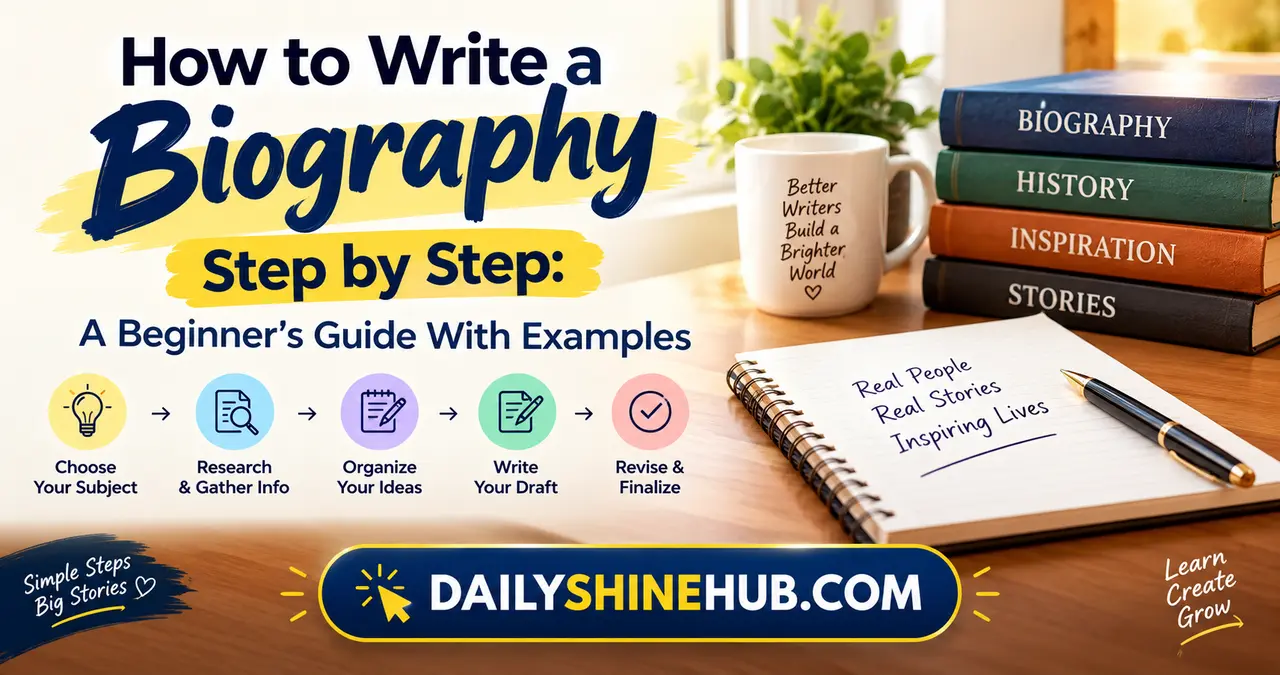
Every life has a story worth telling, but most first-time writers stall at the same spot: staring at a blank page, unsure where a life story even begins.
The good news is that a biography isn’t a mystery. It’s a research project wrapped in a narrative, and both parts can be learned.
This guide shows you how to write a biography from first idea to final draft. You’ll get a clear process, practical examples, and the common mistakes to avoid.
Key Takeaways
- A biography is a true account of a real person’s life, built on research rather than imagination.
- Pick a clear angle before you write. A biography that tries to cover everything usually says nothing memorable.
- Use primary sources (letters, interviews, records) first, and secondary sources (books, articles) to fill gaps.
- Build a timeline before drafting so the structure holds together.
- Open with a scene or moment, not a birth date.
- Fact-check every claim, and credit your sources.
What Is a Biography?
A biography is a detailed written account of a person’s life, told by someone else. It covers events, relationships, achievements, and struggles, and it tries to explain why the person became who they were.
It differs from an autobiography, which the subject writes themselves. It also differs from a memoir, which focuses on a slice of the author’s own life.
If you want a quick overview of the genre and its history, the Wikipedia entry on biography is a solid starting point.
How to Write a Biography: 8 Steps
Step 1: Choose Your Subject and Your Angle
Your subject might be a public figure, a family member, a local hero, or a historical name nobody has covered well.
Then decide on your angle. This is the single idea your biography keeps returning to.
For example, a biography of a famous chef could be about:
- How poverty shaped their cooking
- Their rivalry with a mentor
- The year their restaurant nearly collapsed
Same person, three very different books. An angle gives you permission to leave things out.
Step 2: Define Your Audience and Purpose
Ask yourself who will read this. A school project, a family keepsake, a blog post, and a published book each call for a different depth and tone.
Write one sentence that completes this: “After reading this, my audience will understand ______.”
That sentence becomes your compass when you’re deep in the research.
Step 3: Research Like an Investigator
Good research is what separates a biography from a long Wikipedia summary.
Primary sources
These come straight from the subject’s life:
- Letters, diaries, and emails
- Photographs and home videos
- Birth, school, and employment records
- Interviews with the subject, if they’re alive
Secondary sources
These interpret the life from outside:
- Published books and newspaper articles
- Documentaries and recorded speeches
- Academic papers and archives
Start broad, then narrow. Take notes as you go, and write down the source of every fact the moment you find it. You’ll thank yourself later.
Step 4: Conduct Interviews
If people who knew your subject are available, talk to them. Family, friends, colleagues, and even critics add texture no document can.
Some tips that work:
- Ask open-ended questions (“What was he like when no one was watching?”)
- Ask for specific stories, not general opinions
- Record the conversation, with permission
- Ask the same question to different people and compare answers
Memory is unreliable. When two accounts conflict, note it and check a third source.
Step 5: Build a Timeline
Before you write a single paragraph, lay out the major events in order. A simple table or list works.
| Year | Event | Source |
|---|---|---|
| 1952 | Born in Lyon, France | Birth record |
| 1970 | Starts apprenticeship | Interview with brother |
| 1979 | Opens first restaurant | Newspaper archive |
A timeline exposes gaps, such as ten missing years you’ll need to research. It also shows you where the real turning points are.
Step 6: Create Your Structure
Most biographies follow one of two paths.
Chronological structure moves from birth to present (or death). It’s the easiest for beginners and works well for most subjects.
Thematic structure groups chapters by topic, such as “Early Struggles,” “The Breakthrough,” and “Legacy.” It suits complex lives that don’t follow a straight line.
A simple chronological outline looks like this:
- Opening scene (a defining moment)
- Childhood and family background
- Formative experiences and education
- Early career and setbacks
- The turning point
- Peak achievements
- Later years and challenges
- Legacy and impact
Step 7: Write the First Draft
Don’t aim for perfect. Aim for finished.
Open with a scene
Compare these two openings.
Weak: “Maria Santos was born on March 4, 1948, in a small town in Portugal.”
Stronger: “The night the bakery flooded, twelve-year-old Maria Santos carried sacks of flour up the stairs on her back. By morning, she had saved the family business.”
The second version drops the reader into a moment and raises a question. Dates and facts can follow once you’ve earned attention.
Show, don’t just tell
Instead of saying your subject was determined, show it. Describe the 5 a.m. practice sessions, the rejection letters pinned to the wall, the third attempt after two failures.
Keep the voice consistent
Write in third person and past tense for most biographies. Stay objective, even when you admire your subject.
Step 8: Revise, Fact-Check, and Polish
Let the draft rest for a few days. Then read it again with fresh eyes.
Run through this checklist:
- Does every claim trace back to a source?
- Are dates, names, and places correct?
- Does each chapter move the story forward?
- Have you cut tangents that don’t serve your angle?
- Is the language clear and free of clichés?
Reading your work aloud catches awkward sentences faster than silent proofreading.
Biography Writing Example: Before and After
Here’s a short example showing how a flat paragraph becomes engaging.
Before:
“Thomas was a talented engineer. He worked hard and eventually started his own company, which became successful.”
After:
“For three years, Thomas slept in the back of his workshop, soldering circuit boards by lamplight. When his first product finally shipped in 2009, he had $212 left in the bank.”
The revised version uses specific details, concrete numbers, and a human moment. That’s what makes readers care.
Common Mistakes to Avoid
- Writing a résumé in sentence form. Lists of achievements don’t reveal character.
- Turning your subject into a saint or a villain. Real people are complicated, and readers trust balanced portraits.
- Skipping citations. Unsourced claims hurt credibility.
- Inventing dialogue. Only quote what was actually said or documented.
- Ignoring context. Show the world your subject lived in, including the era, culture, and events around them.
Legal and Ethical Considerations
Writing about a living person raises real responsibilities. Publish only what you can support with evidence, and avoid statements that could damage someone’s reputation unfairly.
If you plan to publish a book or monetize a blog post, get permission to use private letters, photographs, or lengthy quotes. When in doubt, ask. For anything involving legal risk, consult a qualified professional.
Frequently Asked Questions
How long should a biography be?
It depends on the purpose. A school assignment may run 500 to 1,500 words, a blog biography 1,500 to 3,000, and a published book 60,000 words or more.
Can I write a biography about someone I know personally?
Yes, and it often makes the writing richer. Just stay honest: verify details with documents and other people so your memory or affection doesn’t tilt the story.
Do I need the subject’s permission?
For public figures, you generally don’t need permission to write about publicly documented facts. For private individuals, it’s good practice to ask, and it’s often necessary if you want access to personal materials.
What’s the difference between a biography and a memoir?
A biography is written by someone else about a person’s entire life or major portion of it. A memoir is the author’s own account of specific experiences, so it’s more personal and less comprehensive.
Final Thoughts
Learning how to write a biography comes down to a handful of habits: choose a sharp angle, research deeply, build a timeline, open with a moment that grabs attention, and check every fact.
Start small if you need to. Write one chapter about one turning point in one life. Once you see how a real person’s story comes alive on the page, you’ll want to keep going.
The people worth writing about are waiting. Pick one, and write the first line today.
Related: Read our detailed guide on Wutawhealth the Tricks: Practical Health and Wellness Tips
DailyShineHub

Ethan Shine is a passionate content strategist, tech enthusiast, and digital media contributor at DailyShineHub. With over 5 years of experience in blogging and search engine optimization, Ethan specializes in breaking down complex topics into clear, actionable insights. When he isn’t researching the latest industry trends, he enjoys exploring global news, digital tools, and modern lifestyle concepts.