
Planning a trip to Italy can feel overwhelming because the country offers far more than most travelers can fit into one vacation. From the ancient streets of Rome and Renaissance treasures in Florence to the canals of Venice, the Amalfi Coast, Tuscany, and the Italian lakes, every destination has a strong reason to visit.
The best approach is not to try to see everything.
Instead, build your Italian vacation around a realistic route, choose destinations that connect efficiently, and leave enough time to actually enjoy each place.
This step-by-step Italy itinerary is designed for first-time travelers who want a practical, customized trip without constantly rushing from one city to another.
Step 1: Decide How Many Days You Have for Italy
Before choosing hotels or booking flights, determine the length of your trip.
Your available time should control your itinerary—not the other way around.
A 7-day trip is best focused on two major destinations.
A 10-day trip gives you enough time for three destinations.
A 14-day trip allows a more relaxed route covering four or five areas.
If you have only one week, trying to combine Rome, Florence, Venice, Milan, Naples, and the Amalfi Coast will create more transportation time than sightseeing time.
A Practical Italy Trip Length Guide
| Trip Length | Recommended Route | Best For |
|---|---|---|
| 5–7 days | Rome + Florence | First-time travelers |
| 8–10 days | Rome + Florence + Venice | Classic Italy experience |
| 11–14 days | Rome + Florence + Venice + Tuscany | Culture, food, and scenery |
| 14–18 days | Rome + Florence + Venice + Amalfi Coast | A comprehensive first trip |
| 3+ weeks | Northern + Central + Southern Italy | Slow travel and exploration |
A good rule is to spend at least two or three nights in most destinations.
Step 2: Choose the Best Italian Route
Italy is long and geographically diverse, so route planning matters.
For a first trip, a northbound or southbound route using Italy’s major high-speed rail network can be particularly convenient.
One of the simplest classic routes is:
Rome → Florence → Venice
This route works well because the cities are connected by frequent trains and each offers a distinctly different experience.
Rome provides ancient history and monumental architecture.
Florence focuses on Renaissance art, museums, architecture, and Tuscan culture.
Venice offers canals, historic neighborhoods, islands, and a completely different atmosphere.
Why This Route Works for First-Time Visitors
You can experience three major sides of Italy without spending excessive time traveling between destinations.
You also avoid repeatedly returning to the same airport or city.
For an open-jaw trip, consider flying into Rome and departing from Venice if airfare and schedules make sense.
If you plan to extend your journey by car or explore scenic routes beyond the major cities, see our road trip ideas for additional inspiration.
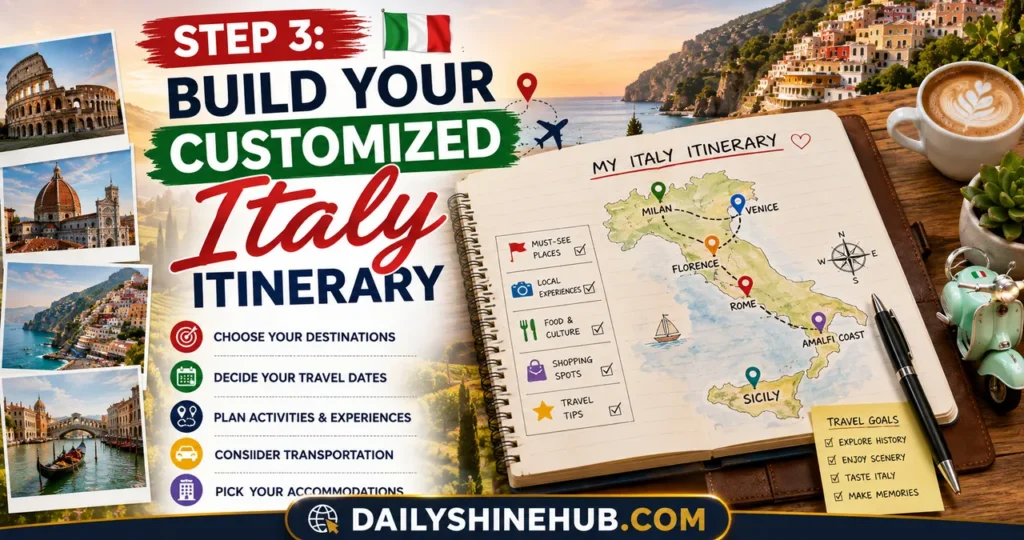
Step 3: Build Your Customized Italy Itinerary
Now you can start assigning nights to each destination.
For a 10-day first-time itinerary, a practical structure would be:
Days 1–3: Rome
Days 4–6: Florence
Days 7–9: Venice
Day 10: Departure
This schedule gives you enough time to experience the highlights while avoiding an exhausting checklist-style vacation.
If you have additional days, consider adding Tuscany, the Amalfi Coast, Bologna, Milan, Lake Como, or Naples depending on your interests.
Days 1–3: Explore Rome
Rome deserves several days because its major attractions are spread throughout the city.
Your first day should focus on getting oriented rather than immediately filling every hour with sightseeing.
Day 1: Historic Rome
Start around the historic center.
Visit the Trevi Fountain, Pantheon, and surrounding piazzas.
Spend time walking rather than attempting to visit every attraction.
Rome rewards travelers who explore side streets, stop for coffee, and discover small restaurants away from the busiest tourist areas.
In the evening, explore neighborhoods such as Trastevere for dinner and a more local atmosphere.
Day 2: Ancient Rome
Dedicate your second day to ancient Roman history.
Start with the Colosseum, then explore the Roman Forum and Palatine Hill.
These attractions can take several hours, particularly if you enjoy historical sites.
Afterward, slow down.
Visit a nearby café, enjoy gelato, or walk through another historic neighborhood.
Day 3: Vatican City and Flexible Rome
Reserve part of your third day for Vatican City, including the Vatican Museums and St. Peter’s Basilica.
Book major attractions in advance when reservations are available.
Use the rest of the day for something that matches your interests.
Art lovers might visit another museum.
Food-focused travelers can take a cooking class or food tour.
Photographers can explore quieter streets during the late afternoon.
Days 4–6: Florence and Tuscany
Travel from Rome to Florence by high-speed train.
The journey is generally much easier than renting a car for this section of the trip.
Florence is compact enough that many central attractions can be reached on foot.
Day 4: Arrive and Discover Florence
After checking into your hotel, explore the historic center.
See the Duomo, walk through Piazza della Signoria, and cross the Ponte Vecchio.
Don’t overload your first Florence day.
The city is ideal for wandering.
Spend your evening enjoying Tuscan food and exploring the streets after the largest crowds have disappeared.
Day 5: Renaissance Florence
Dedicate the day to Florence’s artistic heritage.
Visit the Uffizi Gallery if Renaissance art interests you.
You may also want to visit the Accademia Gallery, famous for Michelangelo’s David.
Because museums can become crowded, schedule the attractions you most want to see and leave flexible time around them.
Make Florence About More Than Museums
Florence is often treated as a collection of famous artworks.
That misses part of its appeal.
Spend time in local markets, cafés, artisan shops, and neighborhood streets.
Climb to Piazzale Michelangelo around sunset for panoramic views of Florence.
Day 6: Add a Tuscany Experience
If you have three nights in Florence, consider using your third day for Tuscany.
Possible choices include:
- Siena
- San Gimignano
- Chianti
- Lucca
- A winery-focused excursion
- A countryside food tour
A guided day trip can be convenient if you do not want to rent a car.
If you prefer a slower vacation, however, staying in Florence for the entire day is perfectly reasonable.
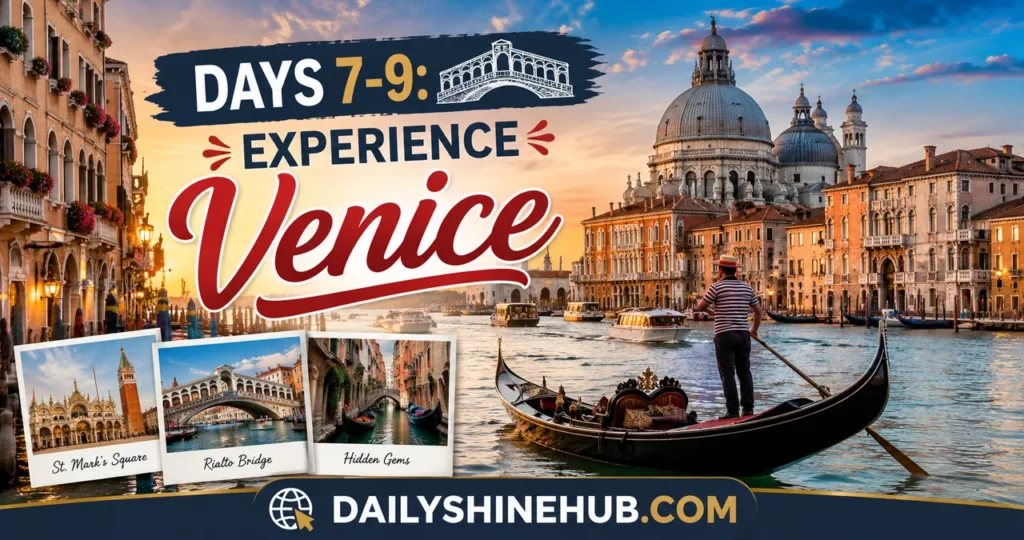
Days 7–9: Experience Venice
Take the train from Florence to Venice.
Arriving in Venice feels dramatically different from arriving in most Italian cities.
Instead of immediately trying to conquer every attraction, allow yourself time to understand the city’s unusual layout.
Day 7: Venice Orientation
After checking in, explore the area around your accommodation.
Walk toward St. Mark’s Square, cross historic bridges, and wander away from the busiest routes.
Venice becomes especially atmospheric in the evening.
Consider having dinner away from the most heavily touristed areas.
Day 8: St. Mark’s and the Grand Canal
Spend the morning exploring St. Mark’s Square and nearby attractions.
Depending on your interests, visit St. Mark’s Basilica, the Doge’s Palace, or another historic site.
Later, explore the Grand Canal.
A vaporetto ride can double as transportation and sightseeing.
You don’t necessarily need an expensive private boat tour to appreciate Venice from the water.
Day 9: Explore the Islands or Hidden Venice
Use your final full day for a different side of Venice.
Consider visiting Murano for its glassmaking tradition or Burano for its colorful architecture.
Alternatively, stay within Venice and explore quieter neighborhoods.
This is also your opportunity to slow down before your journey home.
Step 4: Customize the Itinerary Around Your Travel Style
The basic Rome–Florence–Venice route works for many travelers, but customization makes the trip much better.
For Food Lovers
Add Bologna, Emilia-Romagna, Tuscany, or Naples.
Prioritize markets, cooking classes, food tours, and regional restaurants instead of trying to visit every museum.
For History Lovers
Give Rome additional time.
Consider adding Pompeii, Naples, or other archaeological destinations.
For Nature and Scenery
Consider replacing one major city with the Amalfi Coast, Dolomites, Lake Como, or Tuscany.
The ideal itinerary depends heavily on whether you prefer mountains, beaches, lakes, or countryside.
For Couples
Avoid scheduling every hour.
Choose scenic hotels, sunset experiences, wine excursions, leisurely dinners, and smaller towns.
For Families
Keep transportation simple.
Avoid changing hotels every night and include parks, interactive museums, gelato stops, and activities that appeal to children.
Step 5: Choose Your Transportation Strategy
Italy can be surprisingly easy to travel around when you combine trains with occasional local transportation.
For major city-to-city journeys, trains are often the most convenient option.
When to Use Trains
Use trains for routes such as:
Rome → Florence
Florence → Venice
Rome → Naples
Milan → Florence
High-speed trains can save substantial time compared with driving.
When a Rental Car Makes Sense
A rental car becomes more useful in rural areas.
For example, Tuscany’s countryside is much easier to explore independently by car.
The same can apply to certain parts of Puglia, Sicily, or the Dolomites.
However, avoid renting a car simply because you think you need one for Italy.
Driving and parking in historic city centers can be inconvenient.
Step 6: Select Accommodation Strategically
Where you stay can dramatically affect how enjoyable your trip feels.
For major cities, choose accommodation based on location rather than simply the lowest price.
Staying reasonably close to major attractions or transportation can reduce daily commuting.
What to Look For
Check:
- Distance from the main train station
- Access to public transportation
- Walkability
- Neighborhood atmosphere
- Luggage accessibility
- Air conditioning during summer
- Elevator availability
- Guest reviews
- Cancellation conditions
A slightly more expensive hotel in a convenient location can sometimes save both time and transportation costs.
Step 7: Plan Your Daily Schedule Without Overplanning
One of the biggest mistakes first-time visitors make is scheduling too much.
Instead of planning eight major attractions in one day, select two or three priorities.
For example:
Morning: Major attraction
Lunch: Local restaurant
Afternoon: Neighborhood exploration
Evening: Dinner and relaxed sightseeing
This structure gives you flexibility.
Italy is a destination where spontaneous discoveries can become some of your favorite memories.
Leave Buffer Time for Travel
A train journey may only take a couple of hours, but your actual door-to-door travel time includes:
Hotel checkout
Getting to the station
Waiting for the train
Finding your platform
Traveling
Getting from the station to your next hotel
Checking in
Therefore, don’t treat transportation time as completely separate from your sightseeing schedule.
Step 8: Book the Right Things in Advance
You do not need to pre-book every minute of your vacation.
However, certain experiences deserve advance planning.
These can include:
- Popular museums
- Major archaeological attractions
- Popular guided tours
- High-demand restaurants
- Special experiences
- Long-distance transportation during busy periods
Create a simple booking checklist before departure.
Keep confirmations accessible offline in case mobile service is unreliable.
Step 9: Prepare a Realistic Italy Budget
Italy can accommodate different travel budgets.
Your biggest costs will usually include flights, accommodation, transportation, food, attractions, and activities.
A luxury trip can become expensive quickly, while travelers staying in moderately priced accommodation and using trains can manage costs more carefully.
Ways to Control Costs
Stay slightly outside the most expensive tourist streets.
Eat some meals at local cafés or markets.
Use public transportation.
Walk between nearby attractions.
Book accommodation with breakfast when the price difference is reasonable.
Avoid unnecessary taxis.
Most importantly, don’t sacrifice your entire travel experience simply to save a small amount of money.
Step 10: Adjust Your Route Before You Book
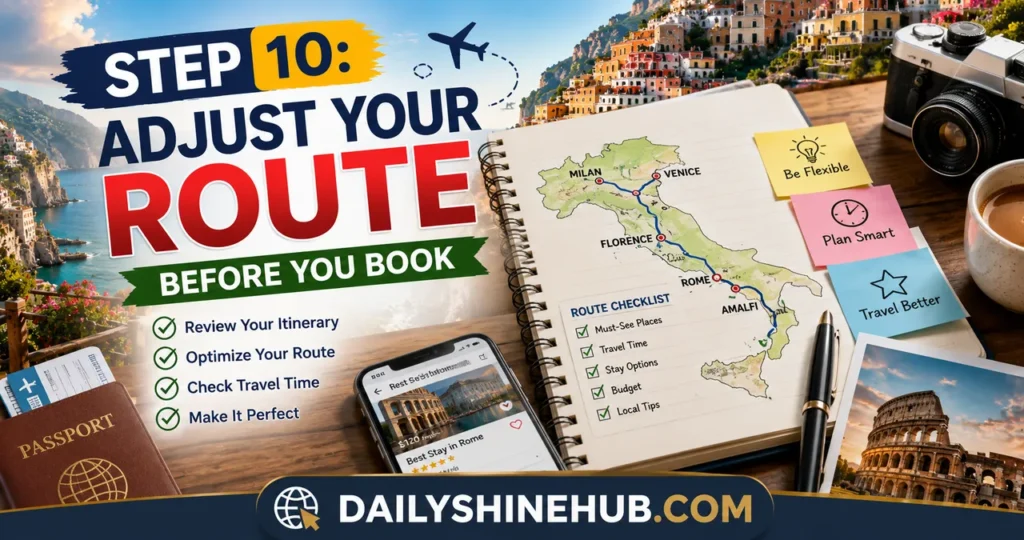
Before making non-refundable reservations, review your itinerary one final time.
Ask yourself:
Am I spending enough time in each destination?
Are my travel days too busy?
Do I have enough recovery time after arriving?
Does every destination match my interests?
Could I remove one city and enjoy the others more?
If the answer to the final question is yes, remove the city.
A successful Italy vacation isn’t measured by the number of places you photograph.
It’s measured by how much you actually experience.
A Practical 10-Day Italy Plan at a Glance
Day 1: Arrive in Rome and explore the historic center
Day 2: Colosseum, Roman Forum, and ancient Rome
Day 3: Vatican City and flexible Rome
Day 4: Train to Florence and explore the city
Day 5: Renaissance museums and central Florence
Day 6: Tuscany day trip or relaxed Florence
Day 7: Train to Venice and evening exploration
Day 8: St. Mark’s Square, Doge’s Palace, and Grand Canal
Day 9: Murano, Burano, or quieter Venice
Day 10: Departure
Final Tips for Planning Your Italy Trip
The most practical way to plan Italy is to work backward from your available vacation days.
Start with your arrival and departure cities.
Then select two or three destinations.
Next, arrange transportation between them.
After that, book strategically located accommodation.
Finally, reserve only the attractions and experiences that genuinely require advance planning.
Don’t attempt to turn Italy into a checklist.
Give yourself time to sit at a café, walk without a destination, enjoy a long dinner, and discover streets that weren’t included in your original plan.
A carefully customized itinerary should provide structure without eliminating spontaneity.
FAQs About Planning a Step-by-Step Trip to Italy
1. What is the best Italy itinerary for first-time visitors?
A Rome, Florence, and Venice itinerary is one of the easiest choices for first-time visitors. It combines ancient history, Renaissance culture, art, food, architecture, and the distinctive atmosphere of Venice without requiring an excessively complicated route.
2. How many days do I need for an Italy trip?
Ten days is a strong starting point for a first trip because it allows approximately three days each in Rome, Florence, and Venice, plus transportation and departure time. Seven days can work if you limit yourself to two destinations.
3. Should I rent a car in Italy?
Not usually for a major-city itinerary. Trains are generally more practical between cities such as Rome, Florence, and Venice. A rental car becomes more useful when exploring rural Tuscany or other areas where public transportation is less convenient.
4. Should I book Italy attractions before traveling?
For highly popular attractions, advance reservations are often a smart idea, particularly during busy travel periods. Book the experiences you consider essential while leaving the rest of your schedule flexible.
5. How can I customize an Italy itinerary?
Start with your interests. History lovers can emphasize Rome and archaeological sites, food lovers can add Bologna or Naples, scenery seekers can include Tuscany or the Italian lakes, and couples may prefer fewer destinations with more relaxed evenings. The best itinerary is the one that matches your interests rather than trying to cover the entire country.

Ethan Shine is a passionate content strategist, tech enthusiast, and digital media contributor at DailyShineHub. With over 5 years of experience in blogging and search engine optimization, Ethan specializes in breaking down complex topics into clear, actionable insights. When he isn’t researching the latest industry trends, he enjoys exploring global news, digital tools, and modern lifestyle concepts.