Sam Elliott is one of Hollywood’s most recognizable actors, famous for his deep voice, distinctive mustache, and decades of work in Westerns, dramas, and television.
Because of his age, appearance, walking style, and the serious illnesses portrayed by some of his characters, questions about his health have circulated online.
One of the most common searches is: “What disease does Sam Elliott have?”
The most accurate answer is that there is no publicly confirmed diagnosis of a serious disease that Sam Elliott has disclosed himself.
Rumors have linked him to cancer, Parkinson’s disease, COPD, neurological disorders, and other conditions, but these claims should not be treated as established facts.
This article separates what is publicly documented from speculation and explains why the rumors surrounding Elliott’s health continue to appear.
The Short Answer: Does Sam Elliott Have a Disease?
Based on publicly available information, Sam Elliott has not publicly confirmed that he has a specific serious disease.
There is no reliable public medical record or statement from Elliott establishing that he has cancer, Parkinson’s disease, COPD, or another major chronic illness.
Several websites have repeated claims about possible illnesses, but repetition does not make an allegation medically verified.
Elliott has generally maintained a relatively private personal life, meaning that the absence of a public diagnosis should not be interpreted as proof that he has never experienced any health problem.
The responsible conclusion is simply that no specific serious disease has been publicly confirmed by Elliott.
That distinction is particularly important when discussing the health of a living person.
Why Are People Searching for Sam Elliott’s Disease?
The question appears to come from several different sources rather than one confirmed medical event.
Fans have noticed changes in Elliott’s appearance and movement as he has grown older.
His naturally rough, gravelly voice has also encouraged some internet users to speculate about possible throat or lung problems.
His filmography has added another layer of confusion.
In several productions, Elliott has played older characters dealing with physical or emotional difficulties, and viewers sometimes connect those fictional conditions with the actor himself.
Online articles can then repeat the original speculation until it begins to look like an established fact.
That is a classic example of how celebrity health rumors develop.
Fact-Check: The Cancer Rumor
One of the biggest misconceptions involves cancer.
The rumor became especially prominent after Elliott starred in The Hero, a 2017 film in which he plays Lee Hayden, an aging actor whose character receives a cancer diagnosis.
The movie deals heavily with mortality, aging, regret, and the uncertainty surrounding the final stage of a person’s life.
Elliott’s performance was convincing enough that some viewers apparently confused the character’s medical situation with the actor’s real life.
However, a character having cancer does not mean the actor portraying that character has cancer.
Contemporary coverage of The Hero focused on Elliott’s performance and the fictional character rather than reporting that Elliott himself had been diagnosed with the disease.
Therefore, claims that Sam Elliott has pancreatic cancer based on The Hero are not supported by evidence.
What About Cancer in Other Roles?
Elliott has portrayed many characters facing difficult circumstances.
His career includes roles involving illness, trauma, aging, grief, and mortality.
These performances can make fictional health conditions feel particularly realistic.
However, audiences should always separate the medical history of a fictional character from the actor’s personal medical history.
This is especially important when searching celebrity health topics because entertainment articles frequently discuss a character’s diagnosis without having anything to do with the actor’s actual health.
Fact-Check: Does Sam Elliott Have Parkinson’s Disease?
Another claim appearing online is that Sam Elliott has Parkinson’s disease.
There is no publicly confirmed diagnosis from Elliott establishing that he has Parkinson’s disease.
Some internet speculation appears to rely on observations of his posture, movement, or head position.
But those observations cannot establish a neurological diagnosis.
Parkinson’s disease is a medical condition requiring professional evaluation, and characteristics such as a particular walking pattern or head position are not sufficient evidence.
Therefore, it would be misleading to say that Elliott has Parkinson’s disease simply because someone believes they have noticed a symptom.
What About His Limp?
The discussion surrounding Elliott’s walking style is another source of confusion.
Some reports have attributed a noticeable limp to a past foot injury, rather than a chronic neurological disease.
One account describes Elliott injuring his foot after tripping over a toy dog and hitting his foot against a bed frame, resulting in a fractured toe and the use of a special shoe during recovery.
That explanation is fundamentally different from saying that he has a progressive neurological disorder.
A previous injury can affect the way someone walks, particularly during recovery.
It also demonstrates why photographs or short video clips should not be used to diagnose celebrities.
Fact-Check: Does Sam Elliott Have COPD?
COPD, or chronic obstructive pulmonary disease, has also been mentioned in online discussions about Elliott.
The speculation appears to be connected partly to his distinctive voice and assumptions about breathing or lung health.
However, there is no reliable public confirmation that Sam Elliott has COPD.
A person’s voice cannot, by itself, establish that they have a lung disease.
For those interested in how respiratory conditions affect daily life, you can explore more about how the body functions and adapts through living with one lung.
Elliott’s famous low, raspy voice has been one of his defining characteristics throughout his career.
It has been part of his professional identity for decades and is frequently associated with his roles as cowboys, ranchers, fathers, and other rugged characters.
Consequently, using his voice as evidence of COPD would be medically irresponsible.
His Famous Voice Is Not Proof of an Illness
Sam Elliott’s voice is perhaps the most recognizable feature of his public image after his appearance.
Because it sounds unusually deep and textured, some people have attempted to connect it with throat or respiratory disease.
There is no public evidence establishing such a diagnosis.
Actors can have naturally distinctive voices, and vocal characteristics can also change gradually with age.
Neither explanation requires a disease diagnosis.
This is an important fact-checking lesson: an unusual physical characteristic is not automatically a symptom of illness.
What Sam Elliott Has Actually Said About His Physical Condition
Although Elliott has generally kept his medical information private, public interviews have occasionally touched on the physical demands of his work.
When discussing 1883, Elliott talked about the demanding conditions associated with filming the series.
The production involved difficult outdoor environments, including extreme heat in Texas and freezing conditions in Montana, and the physical demands contributed to the challenge of the role.
That kind of information provides context about his physical experience as an actor.
It does not, however, establish that he suffers from a particular disease.
This distinction is important because articles sometimes transform comments about physical difficulty, aging, injuries, or demanding work into claims about medical diagnoses.
Sam Elliott’s Age and the Reality of Aging
Sam Elliott was born on August 9, 1944, and turned 82 in August 2026.
At 82, natural changes in appearance, movement, posture, muscle strength, skin, and voice are unsurprising.
But aging itself is not the same thing as having a specific disease.
People can become slower or develop minor physical limitations without having Parkinson’s disease, cancer, COPD, or another serious condition.
This is one reason celebrity health speculation can become misleading.
Viewers see a person they remember from decades ago and naturally compare that younger appearance with how the person looks today.
The difference can be dramatic, but the difference alone does not identify a medical condition.
Fact-Check Table: Rumor vs. Publicly Supported Information
| Health Claim About Sam Elliott | What the Evidence Shows | Fact-Check |
|---|---|---|
| Sam Elliott has cancer | No publicly confirmed diagnosis has been established | Unconfirmed |
| He has pancreatic cancer | Mainly connected to his character in The Hero | False as a proven claim |
| Sam Elliott has Parkinson’s disease | No confirmed public diagnosis | Unconfirmed |
| He has COPD | Online speculation exists, but no reliable confirmation | Unconfirmed |
| His limp proves neurological disease | Reports have connected his limp to a past foot injury | Unsupported |
| His deep voice proves throat or lung disease | No evidence establishes that connection | Unsupported |
| He has experienced physical injuries | A foot injury has been reported | Supported as a reported injury |
| He continues working professionally | Recent coverage shows him continuing to act, including Landman | Supported |
Why Celebrity Health Rumors Spread So Easily
Celebrity health rumors often follow a predictable pattern.
First, someone notices a physical characteristic.
Second, a person proposes a possible explanation.
Third, another website repeats that explanation without adding new evidence.
Eventually, the claim may appear on dozens of pages.
Readers can then mistake the number of websites making the claim for the amount of evidence supporting it.
But ten websites repeating an unsupported rumor do not equal ten independent confirmations.
The same original speculation may simply have been copied from one article to another.
This is why fact-checking requires looking for primary statements, reputable reporting, and credible documentation rather than counting search results.
His Continued Career Provides Useful Context
Another reason the rumors deserve careful examination is Elliott’s continued professional activity.
Recent coverage shows him remaining active in entertainment.
He appeared in Landman and has continued discussing his career, including his long association with the voice of Smokey Bear.
His continued work does not prove that he is perfectly healthy.
An actor can work while managing many different health conditions.
However, it does demonstrate that claims suggesting he has disappeared from public life because of a confirmed terminal illness should be treated with skepticism.
What Can We Actually Say About Sam Elliott’s Health?
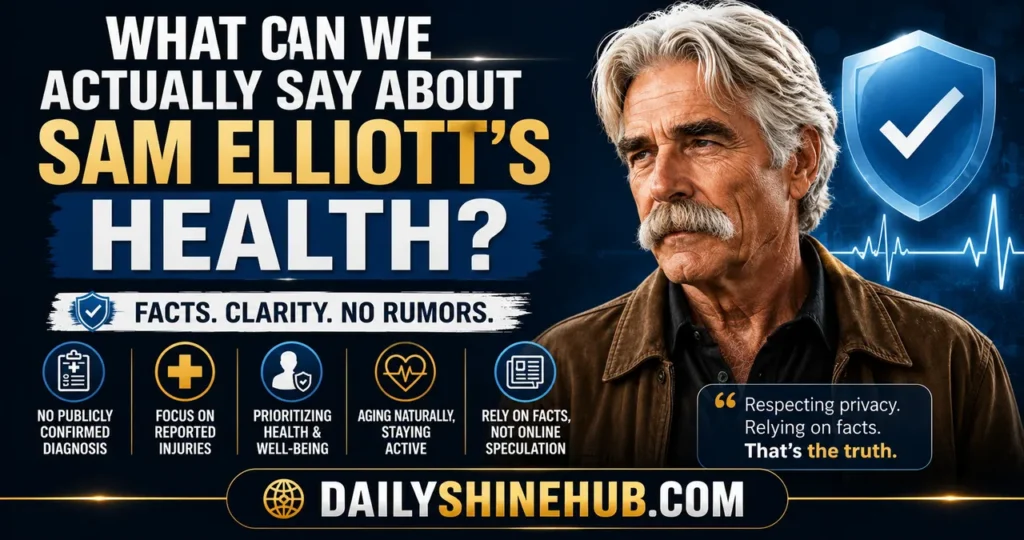
The strongest conclusion supported by available public information is relatively simple.
Sam Elliott has not publicly confirmed a specific serious disease.
Claims involving cancer, Parkinson’s disease, COPD, neuropathy, or other major conditions remain unsupported unless Elliott himself or a credible representative provides confirmation.
A past foot injury has been reported and can help explain why people have noticed a limp.
His age may also account for some visible changes that fans interpret as symptoms.
Most importantly, it is not appropriate to diagnose someone from photographs, videos, voice recordings, movie performances, or walking patterns.
Only a qualified medical professional with access to appropriate clinical information can diagnose a disease.
The Truth Behind “What Disease Does Sam Elliott Have?”
So, what disease does Sam Elliott have?
There is no specific serious disease that has been publicly confirmed by Sam Elliott.
The cancer rumor appears to be strongly connected to his fictional role in The Hero.
The Parkinson’s speculation is not supported by a confirmed diagnosis.
The COPD theory remains speculation rather than established fact.
His limp has been associated in reports with a foot injury, not proof of a neurological disorder.
And his distinctive voice should not be treated as evidence of throat or lung disease.
As of the latest available public information, Elliott remains professionally active and continues to appear in entertainment projects.
For readers interested in celebrity fact-checking, the most responsible approach is to distinguish confirmed information, reported injuries, fictional movie plots, and internet speculation.
In Sam Elliott’s case, those categories have frequently been mixed together.
The bottom line is therefore clear: there is no publicly verified evidence establishing that Sam Elliott has a particular serious disease.
FAQs About Sam Elliott’s Health
1. Does Sam Elliott have cancer?
There is no publicly confirmed evidence that Sam Elliott has cancer.
The cancer rumor is often connected to The Hero, in which Elliott portrays an aging actor diagnosed with cancer.
That diagnosis belongs to the fictional character, not established evidence about Elliott’s real-life health.
2. Does Sam Elliott have Parkinson’s disease?
There is no publicly confirmed diagnosis showing that Sam Elliott has Parkinson’s disease.
Observations about his walking style, posture, or movements cannot establish a neurological diagnosis.
3. Why does Sam Elliott sometimes appear to limp?
Reports have attributed his limp to a previous foot injury involving a fractured toe.
A past injury should not automatically be interpreted as evidence of Parkinson’s disease or another chronic condition.
4. Does Sam Elliott have COPD?
There is no reliable public confirmation that Sam Elliott has COPD.
Online speculation appears to have been influenced partly by his distinctive voice and assumptions about his breathing, but those observations are not sufficient to establish a medical diagnosis.
5. What is the most accurate information about Sam Elliott’s health?
The most defensible answer is that no specific serious disease has been publicly confirmed by Elliott.
There have been reports of a past foot injury, and natural aging can account for some visible changes.
However, claims about cancer, Parkinson’s disease, COPD, or other serious illnesses should not be presented as facts without reliable medical or first-party confirmation.

Ethan Shine is a passionate content strategist, tech enthusiast, and digital media contributor at DailyShineHub. With over 5 years of experience in blogging and search engine optimization, Ethan specializes in breaking down complex topics into clear, actionable insights. When he isn’t researching the latest industry trends, he enjoys exploring global news, digital tools, and modern lifestyle concepts.