
The market for kitchen gadgets wholesale has expanded far beyond traditional utensils. Retailers, online sellers, restaurants, gift stores, supermarkets, and small resellers can now source everything from vegetable cutters and measuring tools to smart kitchen accessories and compact appliances in bulk. The attraction is simple: buying larger quantities can reduce per-unit costs, create consistent inventory, and make it easier to build themed product collections.
For businesses, however, wholesale buying is not simply about finding the lowest price. Product quality, minimum order quantities (MOQs), packaging, shipping, food-contact safety, warranty support, and supplier reliability can have a major effect on the final cost and customer experience. Current wholesale marketplaces also show a broad range of kitchen tools and gadgets, with many suppliers offering relatively low opening-order requirements for independent retailers.
| Key Factor | What Buyers Should Check |
|---|---|
| Product categories | Utensils, cutters, organizers, storage, baking tools, gadgets, small appliances |
| Buying model | Wholesale, distributor, manufacturer, marketplace, direct import |
| MOQ | Minimum number or value required per order |
| Material | Stainless steel, silicone, plastic, glass, wood, aluminum |
| Quality | Durability, finish, usability, packaging and defect rate |
| Shipping | Freight, delivery time, dimensional weight and customs |
| Food-contact safety | Material suitability and documentation where applicable |
| Best customers | Retailers, resellers, restaurants, gift shops and e-commerce stores |
| Pricing strategy | Unit cost + freight + duties + packaging + operating costs + margin |
What Is Kitchen Gadgets Wholesale?
Kitchen gadgets wholesale refers to purchasing kitchen-related products in quantities or under commercial pricing arrangements intended for resale, distribution, hospitality use, or business operations. Instead of purchasing one item at a normal consumer retail price, a buyer may order dozens, hundreds, or mixed cartons depending on the supplier’s terms.
Common wholesale products include:
- Vegetable cutters and slicers
- Manual choppers
- Measuring cups and spoons
- Silicone spatulas and kitchen brushes
- Graters and peelers
- Kitchen scissors
- Food storage containers
- Spice organizers
- Oil dispensers
- Baking accessories
- Digital kitchen scales
- Coffee and beverage accessories
- Drawer and cabinet organizers
- Small countertop appliances
- Novelty and gift-oriented kitchen gadgets
A useful distinction is that wholesale does not automatically mean “factory direct.” A wholesaler may purchase from manufacturers and redistribute products, while a distributor may represent several brands. A marketplace may connect independent retailers with many different suppliers. These models can have very different MOQs, payment terms, delivery times, and support policies.
Why Kitchen Gadgets Wholesale Appeals to Retailers
The biggest attraction is the ability to create a broader product assortment without paying individual retail prices for every unit. A retailer can test several categories and determine which products generate repeat sales.
Important advantages can include:
- Lower unit costs: Larger orders may qualify for volume pricing.
- Broader inventory: Sellers can offer multiple variations of similar products.
- Better merchandising: Related gadgets can be bundled into themed collections.
- Resale flexibility: Products can be sold through stores, marketplaces, social commerce, or websites.
- Private-label potential: Some manufacturers offer customized packaging or branding.
- Repeat purchasing: Everyday kitchen products can create recurring demand.
- Gift opportunities: Novelty gadgets can complement seasonal and occasion-based merchandise.
Current wholesale platforms illustrate how flexible the category has become. Faire, for example, reports thousands of brands and a large selection of kitchen tools and appliances, while some suppliers offer opening orders at relatively modest minimum values.
Kitchen Gadgets Wholesale: Popular Product Categories
A successful wholesale assortment usually combines practical products with visually appealing or problem-solving gadgets. Instead of filling a warehouse with one item, retailers can create a balanced selection.
1. Food Preparation Tools
These are among the easiest products to understand and demonstrate.
Examples include:
- Vegetable slicers
- Peelers
- Garlic presses
- Graters
- Manual choppers
- Herb scissors
- Citrus squeezers
- Egg separators
- Measuring tools
Products that solve a recognizable everyday problem can be particularly useful for e-commerce demonstrations because customers can immediately see how the product works.
2. Storage and Organization Products
Kitchen organization continues to be an important category for retailers because these products combine utility with visual appeal.
Popular options include:
- Refrigerator organizers
- Spice racks
- Drawer dividers
- Container sets
- Shelf organizers
- Sink organizers
- Cutlery trays
- Food-storage accessories
When buying kitchen gadgets wholesale, pay attention to dimensions. A low-cost organizer can become expensive if its bulky packaging dramatically increases shipping costs.
3. Baking Accessories
Baking products can create strong category depth without requiring every item to be an electrical appliance.
Consider:
- Silicone molds
- Dough scrapers
- Measuring spoons
- Rolling accessories
- Decorating tools
- Pastry brushes
- Cookie cutters
- Cake decorating accessories
Bundling several complementary items can make a basic product assortment more attractive.
4. Smart and Tech-Enabled Kitchen Gadgets
The technology side of the kitchen category includes digital scales, rechargeable devices, electric choppers, timers, temperature tools, and compact appliances.
Before ordering electronic products, check:
- Voltage requirements
- Plug type
- Battery specifications
- Charging method
- Warranty arrangements
- Certification requirements
- Replacement-part availability
- Packaging instructions
Electrical compatibility becomes especially important when importing products across countries. Some suppliers specifically advise buyers to confirm the destination market because voltage and plug standards differ.
How to Choose a Kitchen Gadgets Wholesale Supplier
Supplier selection can influence your business more than the product itself. A supplier with a slightly higher unit price may still be more economical if it delivers consistent quality, accurate quantities, reliable packaging, and fewer defective units.
Use this checklist:
- Verify business information. Look for a real business address, contact details, catalog, and clear commercial terms.
- Request product specifications. Ask about materials, dimensions, weight, packaging, and intended use.
- Check MOQ requirements. A low unit price is less useful if the required order is too large for your cash flow.
- Order samples. Test products before committing to a large shipment.
- Ask about defective products. Understand replacement, refund, and credit policies.
- Compare landed cost. Include freight, customs, taxes, packaging, and handling.
- Review lead times. A cheap product that arrives late can create stock shortages.
- Confirm customization options. Ask whether private labeling or branded packaging is available.
- Check communication quality. Slow or unclear responses can become a serious problem after payment.
- Keep documentation. Save quotations, invoices, specifications, inspection reports, and correspondence.
Kitchen Gadgets Wholesale and Product Safety
Product safety deserves special attention because many kitchen gadgets directly or indirectly contact food. In the United States, the FDA treats substances that come into contact with food as a regulated area, including materials used in cookware, food preparation surfaces, packaging, and containers.
For products intended for food contact, buyers should ask suppliers for appropriate documentation rather than relying solely on phrases such as “food grade” in a product listing.
Important checks include:
- Material composition
- Intended food-contact use
- Temperature limitations
- Cleaning instructions
- Migration or compliance documentation where relevant
- Manufacturer information
- Batch or product identification
- Country-specific requirements
The FDA also maintains an inventory covering certain food-contact substances authorized under specified conditions, which can be useful when researching applicable materials and uses.
For general kitchen safety information, buyers and retailers can also consult the FDA’s guidance on food safety in the kitchen.
How to Calculate Kitchen Gadgets Wholesale Costs
The wholesale price shown by a supplier is rarely the final cost. A more realistic calculation includes every expense required to get the product ready for sale.
A simple formula is:
Landed Cost = Product Cost + Freight + Insurance + Customs/Duties + Taxes + Packaging + Handling Fees
For example, suppose a retailer purchases 500 gadgets at $2 each. The product invoice is $1,000, but shipping, import charges, packaging, and other expenses may increase the effective cost per unit.
Before placing an order, calculate:
- Supplier unit price
- Quantity
- Shipping cost
- Import duties
- Local taxes
- Payment processing fees
- Warehousing
- Packaging
- Product inspection
- Expected defective units
- Marketplace fees
- Advertising costs
This approach prevents the common mistake of calculating profit from the supplier’s price alone.
Kitchen Gadgets Wholesale for Small Businesses
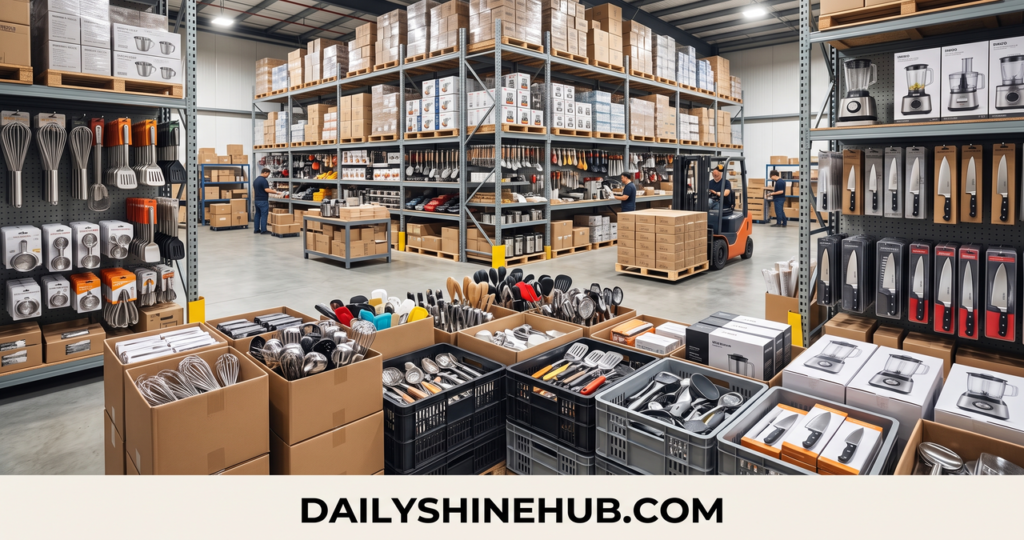
Small businesses do not necessarily need enormous quantities to enter the category. Some current wholesale platforms advertise low minimums or relatively small opening-order requirements, making product testing more accessible to independent retailers.
A practical starting strategy is to:
- Select 5–10 product types.
- Order smaller quantities initially.
- Test customer response.
- Track sales and returns.
- Reorder successful products.
- Remove slow-moving inventory.
- Gradually negotiate better volume pricing.
This reduces the risk of investing heavily in a product before knowing whether customers actually want it.
Kitchen Gadgets Wholesale in Pakistan
Pakistan has an active market for kitchen accessories, household products, and small gadgets, with suppliers offering products through physical wholesale channels and online stores. Current listings include kitchen tools, organizers, scales, cutters, baking accessories, and other household products.
For Pakistani retailers, important considerations include:
- Local delivery charges
- Cash-on-delivery requirements for some sales channels
- Imported-product duties
- Electrical voltage and plug compatibility
- Product packaging
- Supplier location
- Replacement policies
- Inventory turnover
- Seasonal demand
Buyers sourcing from Karachi or other commercial hubs can also compare local wholesalers with direct-import options. Some Pakistan-based commercial suppliers publish volume pricing or request-for-quote systems for larger orders.
How to Find Profitable Kitchen Gadgets Wholesale Products
Profitability depends on more than markup. A product with a 50% markup may perform worse than one with a smaller markup if it has high return rates, expensive shipping, or slow inventory turnover.
Look for products with several of these characteristics:
- Compact size
- Low breakage risk
- Simple operation
- Easy-to-understand benefits
- Attractive packaging
- Affordable shipping
- Repeat demand
- Good retail presentation
- Low return potential
- Multiple selling channels
Problem-solving products can be especially effective online because their usefulness can be demonstrated through product photos and short videos.
Common Mistakes When Buying Kitchen Gadgets Wholesale
Wholesale buying becomes expensive when decisions are based entirely on attractive product photos or unusually low prices.
Avoid these mistakes:
- Ordering a large quantity without testing samples
- Ignoring shipping dimensions
- Buying electronic products without checking voltage
- Assuming every “food-grade” claim is adequately documented
- Choosing a supplier only because it has the lowest price
- Forgetting import taxes and customs charges
- Ordering too many variations at once
- Ignoring packaging quality
- Failing to establish a defect policy
- Buying trendy products without considering long-term demand
A good wholesale strategy balances price, quality, logistics, compliance, and customer demand rather than optimizing for one factor.
Kitchen Gadgets Wholesale: Online Selling Strategy
E-commerce gives retailers several ways to turn a wholesale inventory into individual sales. A strong product page should answer the questions customers are most likely to have before buying.
Include:
- Clear product photos
- Product dimensions
- Material information
- Instructions
- Compatibility details
- Cleaning information
- Package contents
- Warranty information where applicable
- Delivery estimates
- Honest limitations
Short demonstration videos can be especially effective for gadgets such as cutters, organizers, dispensers, scales, and manual preparation tools because customers can see the product solving a specific problem.
How to Negotiate With Wholesale Suppliers
Negotiation is not always about demanding a lower price. Better terms can sometimes create more value than a small unit-price reduction.
Ask about:
- Volume discounts
- Mixed-carton orders
- Lower MOQs
- Repeat-order discounts
- Private labeling
- Custom packaging
- Sample costs
- Shipping arrangements
- Payment terms
- Replacement policies
- Production lead times
For example, a supplier may not reduce the unit price but could offer better packaging, mixed SKUs, or more favorable shipping terms.
Final Checklist Before Placing a Wholesale Order
Before committing money to kitchen gadgets wholesale, run through a final checklist:
- Supplier verified
- Product samples tested
- Material specifications received
- Food-contact documentation checked where applicable
- MOQ confirmed
- Unit price confirmed
- Shipping quotation received
- Taxes and duties estimated
- Packaging reviewed
- Defect policy confirmed
- Delivery timeline confirmed
- Electrical specifications checked for appliances
- Expected retail price researched
- Profit margin calculated
- Customer demand tested
Conclusion
Kitchen gadgets wholesale can give retailers, resellers, hospitality businesses, and e-commerce sellers access to a wide range of practical and technology-oriented kitchen products at commercial pricing. The strongest approach is not simply to chase the cheapest supplier; it is to compare total landed costs, test product quality, verify specifications, understand MOQs, and choose products that genuinely solve customer problems.
Whether you are sourcing vegetable cutters, organizers, baking accessories, digital kitchen tools, or compact appliances, careful supplier research can reduce unnecessary inventory risk. With sample testing, accurate cost calculations, appropriate safety checks, and a focused product assortment, kitchen gadgets wholesale can become a structured part of a broader retail or online-selling strategy.
Related: Read our detailed guide on House Gadgets: The Complete Guide to Smart, Useful & Modern Home Technology
FAQs
1. What does kitchen gadgets wholesale mean?
Kitchen gadgets wholesale means purchasing kitchen tools, accessories, or related products in commercial quantities or through wholesale pricing arrangements. The products may be intended for retail resale, distribution, restaurants, hospitality businesses, or other commercial uses.
2. What kitchen gadgets are commonly purchased wholesale?
Popular categories include vegetable cutters, peelers, graters, manual choppers, measuring tools, silicone utensils, storage organizers, baking accessories, digital scales, oil dispensers, kitchen scissors, and compact appliances.
3. Is buying kitchen gadgets wholesale cheaper than retail purchasing?
Wholesale purchasing can reduce the per-unit product cost, particularly when quantity discounts apply. However, buyers should calculate the complete landed cost, including freight, taxes, duties, packaging, and handling, before deciding whether an order is economical.
4. How can I check whether a wholesale kitchen gadget is safe?
Review the manufacturer’s specifications, material information, intended use, temperature limits, cleaning instructions, and relevant compliance documentation. For products that contact food, do not rely solely on an unverified “food-grade” claim; requirements can vary by market and intended use.
5. What should I ask a kitchen gadget wholesaler before ordering?
Ask about MOQ, unit pricing, samples, materials, packaging, shipping, lead time, defect replacement, payment terms, customization, warranty coverage for electrical products, and documentation relevant to the destination market.
DailyShineHub

Ethan Shine is a passionate content strategist, tech enthusiast, and digital media contributor at DailyShineHub. With over 5 years of experience in blogging and search engine optimization, Ethan specializes in breaking down complex topics into clear, actionable insights. When he isn’t researching the latest industry trends, he enjoys exploring global news, digital tools, and modern lifestyle concepts.