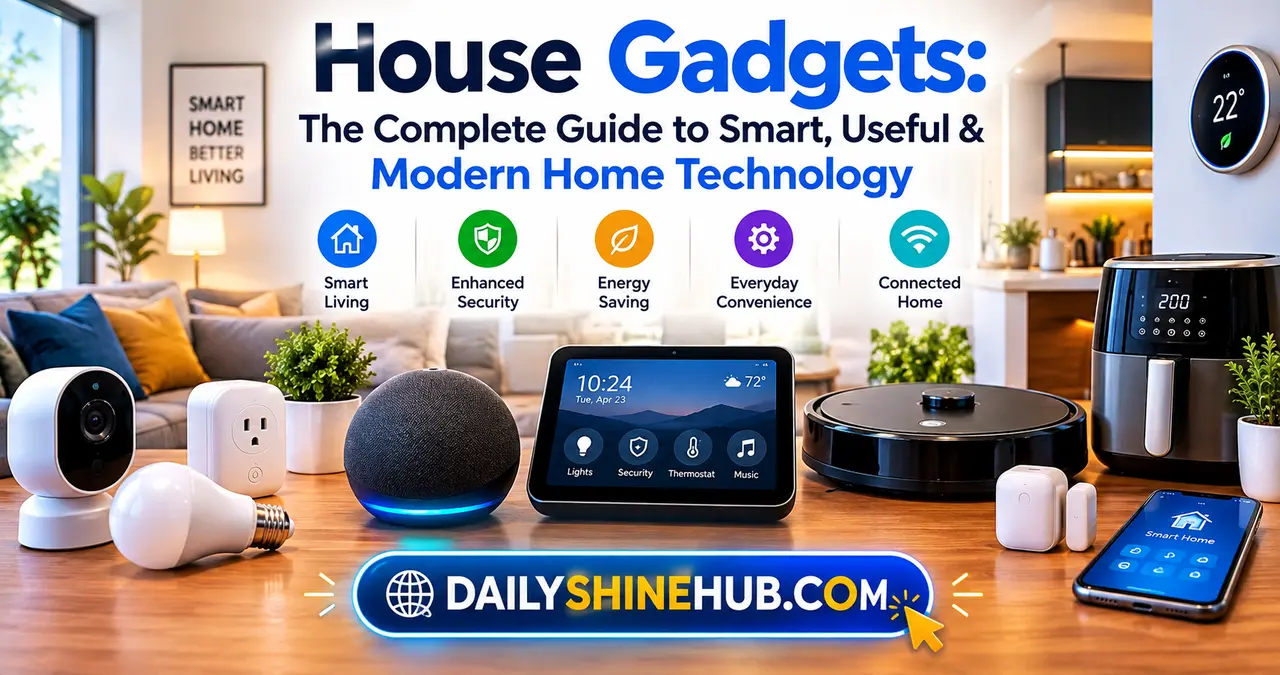
Modern homes are becoming more connected, convenient, and technology-focused, and house gadgets are at the center of that transformation. From smart lighting and automated cleaning devices to connected kitchen appliances, security cameras, smart plugs, and energy-monitoring tools, today’s technology can simplify everyday household tasks without requiring a complete home renovation. The right devices can help save time, improve organization, increase convenience, and provide greater control over different parts of a home.
| House Gadget Category | Main Purpose | Typical Benefit | Connectivity |
|---|---|---|---|
| Smart Lights | Lighting control | Convenience and automation | Wi-Fi, Bluetooth, Matter |
| Smart Plugs | Appliance control | Remote switching | Wi-Fi, Matter |
| Smart Speakers | Voice control | Hands-free commands | Wi-Fi/Bluetooth |
| Security Cameras | Home monitoring | Remote awareness | Wi-Fi |
| Robot Vacuums | Floor cleaning | Automated cleaning | Wi-Fi/app |
| Smart Thermostats | Climate management | Automated temperature control | Wi-Fi |
| Smart Kitchen Devices | Cooking assistance | Convenience and precision | Wi-Fi/Bluetooth |
| Energy Monitors | Usage tracking | Better energy awareness | Wi-Fi |
What Are House Gadgets?
The term house gadgets covers a broad range of electronic and connected devices designed to make household activities easier, safer, more efficient, or more enjoyable. Some are simple devices, such as motion-activated lights or digital timers, while others use sensors, apps, wireless connectivity, and automation to perform tasks with minimal intervention.
Smart-home technology is closely connected with the Internet of Things (IoT), where physical devices can contain sensors, processing capabilities, software, and network connectivity. Home automation can involve lighting, climate control, entertainment, appliances, and security systems, making technology increasingly integrated into ordinary household routines.
Useful examples include:
- Smart bulbs that can be scheduled or controlled from a phone.
- Smart plugs that allow compatible appliances to be switched remotely.
- Video doorbells that provide notifications when activity is detected.
- Robot vacuums that automate routine floor cleaning.
- Smart speakers that provide voice-based control.
- Connected kitchen appliances that offer programmable settings.
- Sensors that monitor doors, windows, temperature, humidity, or motion.
Why House Gadgets Are Becoming More Popular
The growing interest in house gadgets is not simply about having the newest technology. For many homeowners and renters, the appeal comes from solving practical problems.
A connected device can potentially reduce repetitive tasks or make information easier to access. For example, a smart plug can automate a lamp, while a motion sensor can trigger lighting when someone enters a room. Home automation systems can also coordinate multiple devices through schedules or predefined routines.
Key reasons people consider these technologies include:
- Convenience: Control compatible devices without repeatedly operating them manually.
- Automation: Schedule recurring household tasks.
- Security awareness: Receive alerts from compatible cameras and sensors.
- Energy awareness: Monitor or automate certain electrical devices.
- Accessibility: Provide alternative ways to interact with household equipment.
- Organization: Combine multiple functions through a smartphone application or compatible hub.
The concept of a smart home generally involves connected devices working together rather than functioning as completely separate products.
Best House Gadgets for Everyday Convenience
The most useful house gadgets are often the ones that solve small problems repeatedly. A product does not need an impressive specification sheet to be valuable; it needs to fit naturally into the way a household operates.
Smart Lighting
Smart bulbs and switches are among the simplest ways to introduce connected technology into a home. Depending on the product, users may be able to schedule lighting, adjust brightness, create scenes, or control lights through an app or compatible voice assistant.
Consider:
- Adjustable brightness.
- Scheduling options.
- Local control when available.
- Compatibility with your existing electrical setup.
- Support for your preferred smart-home ecosystem.
Smart lighting can be particularly useful for bedrooms, hallways, living rooms, workspaces, and outdoor areas.
Smart Plugs
A smart plug can turn a compatible ordinary appliance into a remotely controllable device. It is useful for lamps, fans, chargers, and other appliances that are appropriate for the plug’s electrical rating.
Before buying one, check:
- Maximum supported electrical load.
- Plug and socket compatibility.
- Wi-Fi or other connectivity requirements.
- App quality and automation options.
- Whether it supports your preferred smart-home platform.
Smart plugs are also a relatively straightforward way to experiment with home automation without replacing existing appliances.
Smart Speakers and Displays
Smart speakers and displays can function as convenient control points for compatible devices. Depending on the ecosystem, users can issue voice commands, create routines, play media, check information, or control connected lights and appliances.
However, privacy should remain part of the purchasing decision. Review microphone controls, account settings, data policies, and available privacy features before placing connected voice devices in frequently used rooms.
House Gadgets for Home Security
Security technology has become one of the most recognizable areas of the smart-home market. Connected cameras, video doorbells, door sensors, motion sensors, and smart locks can provide additional information about activity around a property.
Useful security-oriented house gadgets include:
- Video doorbells: Designed to show activity around an entrance and provide notifications on supported systems.
- Indoor cameras: Useful for monitoring selected indoor areas when appropriately configured.
- Outdoor cameras: Designed for exterior monitoring and environmental conditions.
- Door and window sensors: Can notify users when a monitored opening changes state.
- Smart locks: May allow digital access management depending on the model.
- Motion sensors: Can activate compatible lights, alarms, or automation routines.
Security devices should not be treated as automatically risk-free. Connected equipment can involve accounts, network access, stored footage, and personal information, so strong passwords, software updates, two-factor authentication where available, and careful privacy settings are important.
House Gadgets for the Kitchen
The kitchen is another area where technology can make repetitive tasks more manageable. Modern connected appliances range from smart ovens and multicookers to coffee machines, kitchen scales, thermometers, and timers.
Useful kitchen technology can include:
- Digital food thermometers.
- Smart kitchen scales.
- Programmable coffee makers.
- Air fryers with digital controls.
- Connected multicookers.
- Smart ovens.
- Automatic timers and sensors.
The best device depends on the task rather than the number of features. A simple digital thermometer may be more useful for a particular household than an expensive connected appliance that rarely gets used.
House Gadgets for Cleaning and Organization
Cleaning is one of the strongest use cases for household automation because many tasks are repetitive. Robot vacuums, automated mops, cordless cleaning equipment, smart air purifiers, and sensors can reduce the amount of manual attention required for certain routines.
Robot vacuums are especially interesting because they can combine mapping, sensors, scheduled cleaning, and app controls. Some models can identify areas, create schedules, and return to charging stations automatically.
When comparing cleaning technology, look at:
- Battery life.
- Navigation system.
- Floor compatibility.
- Maintenance requirements.
- Replacement-part availability.
- App functionality.
- Noise levels.
- Ability to handle your home’s layout.
Automation is most useful when maintenance remains manageable. A device that requires frequent cleaning, complicated setup, or expensive replacement parts may be less convenient than expected.
Energy-Saving House Gadgets
Energy-related technology can help homeowners understand how electricity is being used. Smart plugs with energy monitoring, smart thermostats, temperature sensors, and energy meters can provide information that may help identify usage patterns.
Some home automation systems can also coordinate devices based on schedules or sensor information. Home automation has been discussed as a potential way to improve energy efficiency through automated control and monitoring.
Consider these options:
- Smart plugs with energy monitoring.
- Smart thermostats.
- Temperature and humidity sensors.
- Smart power strips.
- Energy-monitoring systems.
- Automated lighting controls.
It is important to distinguish between monitoring and guaranteed savings. A device may show consumption or enable automation, but the actual effect on an electricity bill depends on household behavior, equipment, climate, tariffs, and other factors.
How to Choose House Gadgets Without Wasting Money
Buying every interesting device can quickly create a complicated collection of apps, accounts, chargers, and connectivity requirements. A more practical strategy is to identify a genuine household problem first and then choose technology that addresses it.
Before buying, ask:
- What problem will this device solve?
- Will I use it regularly?
- Does it work with my current devices?
- Does it require a separate hub?
- Does it continue working if the internet goes down?
- What personal data does it collect?
- How long is manufacturer support expected to last?
- Are replacement parts available?
- What happens if the app or service is discontinued?
Compatibility is particularly important. Standards such as Matter are designed to improve interoperability among smart-home devices from different manufacturers, although compatibility still depends on individual products and ecosystems.
Setting Up House Gadgets Safely
A connected home should be treated as part of your digital environment. Every internet-connected device introduces another account, application, network connection, or software component that may require attention.
Follow these practical steps:
- Use unique passwords for important accounts.
- Enable two-factor authentication when available.
- Keep device firmware and mobile applications updated.
- Secure your home Wi-Fi network.
- Review privacy and data-sharing settings.
- Avoid buying devices from unknown manufacturers without researching support and security.
- Disable unnecessary features or permissions.
- Replace unsupported devices when security updates are no longer available.
A smart home hub can coordinate different devices, but not every connected home needs one. Some devices operate directly through apps or compatible ecosystems, while others benefit from centralized automation.
House Gadgets and the Future of Smart Homes
The next generation of house gadgets is likely to focus increasingly on interoperability, automation, sensors, and more personalized control. Instead of simply responding to individual commands, connected systems can combine information from multiple devices to perform routines.
For example, a future-oriented home setup might coordinate:
- Lighting based on schedules or occupancy.
- Temperature settings based on sensors.
- Security alerts based on door and motion sensors.
- Appliance operation according to predefined routines.
- Energy information across multiple connected devices.
- Cleaning schedules based on household patterns.
The direction of smart-home technology also includes greater attention to local processing and privacy. Industry discussions increasingly consider whether certain information can be processed locally instead of relying entirely on cloud services.
The goal should not be to make every object in a home connected. The goal is to make technology useful, understandable, secure, and easy to maintain.
Common Mistakes When Buying House Gadgets
Even useful technology can become frustrating when purchased without considering the complete system.
Avoid these common mistakes:
- Buying a device solely because it has many features.
- Ignoring compatibility with existing equipment.
- Forgetting about subscription costs.
- Installing too many separate apps.
- Overlooking electrical ratings.
- Assuming every device works during an internet outage.
- Ignoring software-update policies.
- Choosing convenience over basic privacy protections.
- Buying products without checking warranty and replacement support.
A smaller collection of dependable devices can often create a smoother experience than a home filled with disconnected gadgets.
How to Build a Practical Smart Home
You do not need to transform your entire home at once. Start with one area where technology can solve a clear problem.
A sensible progression might be:
- Start with lighting or smart plugs.
- Add a voice assistant or compatible control system if useful.
- Introduce sensors for specific automation routines.
- Consider security devices after reviewing privacy requirements.
- Add cleaning or kitchen technology based on actual needs.
- Create routines connecting compatible devices.
- Review security, permissions, and device updates regularly.
This approach makes it easier to learn how your devices communicate before expanding the system.
Conclusion
The most valuable house gadgets are not necessarily the most expensive or futuristic products. They are the devices that solve real household problems while remaining reliable, compatible, secure, and easy to use. Smart lighting, plugs, security sensors, cleaning robots, kitchen technology, and energy-monitoring devices can all contribute to a more convenient connected home when selected thoughtfully.
Before purchasing new technology, consider compatibility, privacy, maintenance, connectivity, long-term support, and the actual task you want to improve. A carefully planned collection of house gadgets can make everyday routines simpler without turning the home into an unnecessarily complicated network of devices.
Related: Read our detailed guide on Best Callos a la Madrileña Near Me
Frequently Asked Questions
1. What are house gadgets?
House gadgets are electronic or technology-based devices designed to make household activities easier, more convenient, automated, organized, or secure. They can range from simple digital tools to connected smart-home equipment.
2. What are the most useful house gadgets for beginners?
Good starting points can include smart bulbs, smart plugs, digital timers, smart speakers, temperature sensors, and basic security devices. The best choice depends on the specific problem you want to solve.
3. Do house gadgets need Wi-Fi?
Not always. Some devices use Bluetooth, Zigbee, Thread, proprietary wireless connections, or other communication methods. Certain smart-home systems can also provide local control without depending entirely on an internet connection.
4. Are smart house gadgets secure?
Security varies by product, manufacturer, software support, configuration, and user practices. Strong passwords, two-factor authentication, regular updates, secure Wi-Fi, and careful privacy settings can reduce common risks.
5. Can house gadgets save energy?
Some devices can help monitor or automate energy use, but savings are not guaranteed. Actual results depend on the equipment, household behavior, schedules, climate, and electricity usage patterns.
Related Reading
For background on home automation, connected devices, and smart-home systems, see the Wikipedia overview of home automation.
DailyShineHub

Ethan Shine is a passionate content strategist, tech enthusiast, and digital media contributor at DailyShineHub. With over 5 years of experience in blogging and search engine optimization, Ethan specializes in breaking down complex topics into clear, actionable insights. When he isn’t researching the latest industry trends, he enjoys exploring global news, digital tools, and modern lifestyle concepts.