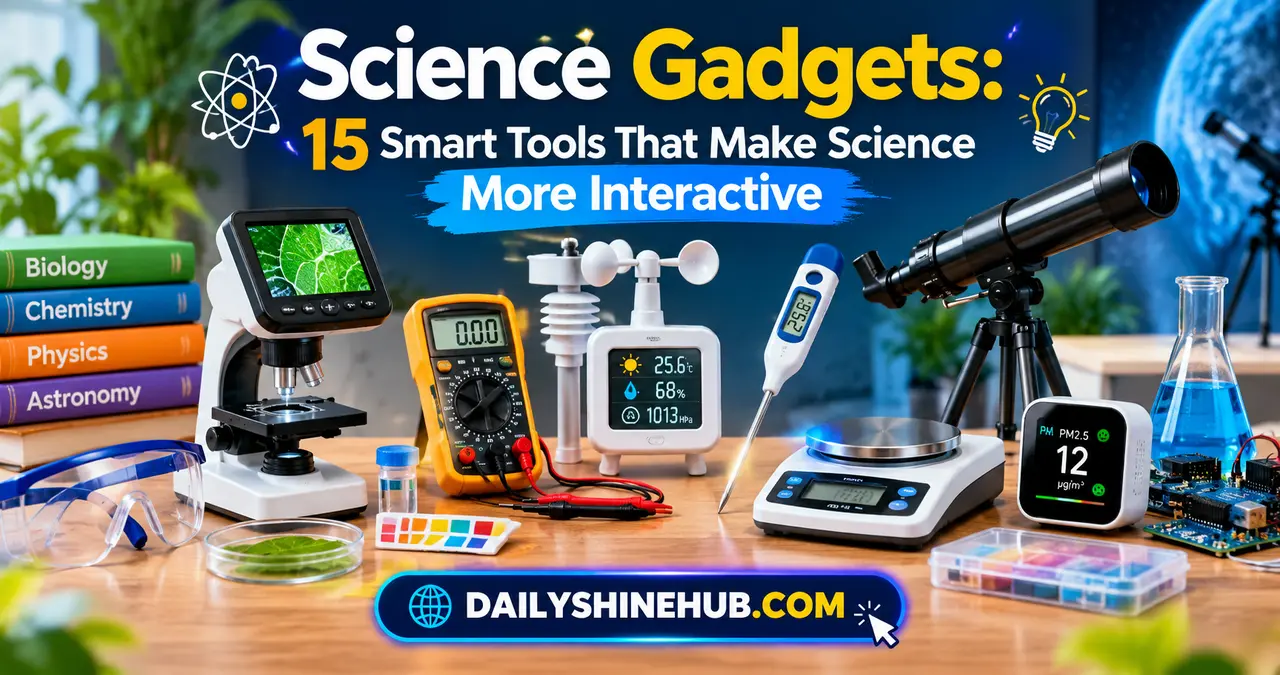
Science is no longer limited to textbooks, laboratories, and complicated equipment. Today, science gadgets bring experiments, measurements, observation, and discovery into classrooms, homes, workshops, and outdoor environments. From digital microscopes that reveal microscopic structures to environmental sensors that measure air quality, modern tools make scientific concepts easier to explore in practical ways.
For students, these devices can turn abstract lessons into hands-on experiences. For hobbyists, they provide an accessible way to investigate nature, electronics, astronomy, chemistry, and physics. Even educators and researchers can use compact digital instruments to collect measurements, visualize results, and demonstrate scientific principles more effectively.
| Feature | Typical Use | Best For |
|---|---|---|
| Digital microscope | Magnifying specimens | Students, hobbyists |
| Digital thermometer | Measuring temperature | Home experiments, classrooms |
| Weather station | Tracking environmental conditions | STEM projects |
| Multimeter | Measuring electrical values | Electronics learners |
| Smart sensors | Collecting scientific data | Students and educators |
| Telescope | Observing celestial objects | Astronomy enthusiasts |
| pH meter | Testing acidity and alkalinity | Chemistry and gardening |
| Electronic scale | Precise mass measurement | Experiments and projects |
| Data logger | Recording measurements over time | Research and STEM |
| Portable spectrometer | Examining light and materials | Advanced learners |
What Are Science Gadgets?
Science gadgets are devices, instruments, or digital tools designed to help people observe, measure, test, analyze, or demonstrate scientific phenomena. They range from simple educational equipment to sophisticated electronic instruments used for professional applications.
A gadget does not necessarily need to be complicated. A basic magnifying glass can support biological observation, while a connected sensor can continuously record temperature or humidity and transfer the information to a smartphone.
Common categories include:
- Observation tools: Microscopes, telescopes, magnifiers, and cameras.
- Measurement devices: Thermometers, scales, pH meters, and light meters.
- Electronics tools: Multimeters, oscilloscopes, circuit testers, and sensors.
- Environmental instruments: Weather stations, air-quality monitors, and water-testing kits.
- Educational STEM devices: Programmable robots, experiment kits, and electronic learning platforms.
The central purpose is practical exploration. Instead of simply reading that temperature changes during a reaction, for example, a learner can use a sensor to measure and record that change.
Why Science Gadgets Matter in Modern Learning
Hands-on experimentation has an important role in STEM education because it connects theoretical knowledge with observable results. A student who measures voltage with a multimeter or examines a leaf through a digital microscope is interacting directly with the subject.
Useful benefits include:
- Making difficult concepts more concrete.
- Encouraging curiosity and experimentation.
- Developing measurement and observation skills.
- Introducing students to real scientific workflows.
- Supporting project-based learning.
- Helping learners understand data collection and analysis.
- Making science activities more interactive.
The best device is not necessarily the most expensive one. A well-designed instrument that solves a specific learning problem can be more useful than an advanced gadget with features the user never needs.
Top Science Gadgets for Students and Hobbyists
1. Digital Microscope
A digital microscope is one of the most accessible tools for exploring the microscopic world. Instead of relying only on an optical eyepiece, many models connect to a computer, tablet, or display so users can view enlarged images on a screen.
Possible projects include:
- Examining plant structures.
- Observing fabric fibers.
- Studying insects.
- Comparing different materials.
- Inspecting small electronic components.
Entry-level models can be suitable for educational exploration, while laboratory microscopes offer considerably greater optical performance.
2. Smart Weather Station
A personal weather station can turn everyday weather into a data-collection project. Depending on the model, it may measure temperature, humidity, atmospheric pressure, wind speed, wind direction, rainfall, or other environmental variables.
Students can use collected information to:
- Create graphs.
- Compare weather patterns.
- Study temperature changes.
- Explore atmospheric pressure.
- Conduct long-term environmental projects.
Weather data can also introduce learners to concepts such as averages, trends, variables, and correlation.
3. Digital pH Meter
A pH meter measures how acidic or alkaline a solution is. It can be useful for educational chemistry experiments, water testing, gardening projects, and demonstrations involving acids and bases.
A digital pH meter generally provides a numerical measurement rather than relying entirely on color-changing indicator paper. Users should still follow the manufacturer’s instructions for calibration, electrode care, storage, and measurement accuracy.
4. Electronic Multimeter
An electronic multimeter is an important tool for anyone exploring basic electronics and electrical science. Depending on the model, it can measure values such as voltage, resistance, and current.
A multimeter can help learners understand:
- Electrical circuits.
- Resistance.
- Batteries.
- Conductivity.
- Series and parallel connections.
- Basic troubleshooting.
Electrical experiments should always be performed within the instrument’s rated limits and with appropriate safety precautions.
5. Digital Thermometer and Temperature Sensors
Temperature is one of the easiest scientific variables to measure, making temperature sensors particularly useful for classroom experiments and home projects.
More advanced sensors can connect to microcontrollers or computers, allowing measurements to be collected automatically. This creates opportunities for experiments involving:
- Heating and cooling.
- Insulation.
- Solar energy.
- Room temperature changes.
- Chemical reactions where temperature monitoring is appropriate.
6. Telescope
Astronomy is one of the areas where technology can make science feel especially tangible. A telescope allows observers to study the Moon and, depending on equipment and observing conditions, planets and other celestial objects.
Beginners should learn basic concepts such as:
- Aperture.
- Magnification.
- Focal length.
- Eyepieces.
- Light pollution.
- Atmospheric conditions.
A larger magnification is not automatically better. Optical quality, aperture, stability, and observing conditions all affect what can actually be seen.
7. Portable Air-Quality Monitor
Air-quality monitors use sensors to detect selected environmental indicators. Depending on the device, these may include particulate matter, carbon dioxide, volatile organic compounds, temperature, or humidity.
Such instruments can support educational projects about:
- Indoor environments.
- Ventilation.
- Particulate pollution.
- Environmental monitoring.
- Data interpretation.
Users should check exactly which pollutants a particular device measures because consumer sensors do not necessarily detect every component of air pollution.
Advanced Science Gadgets for STEM Projects
For learners who want to move beyond simple measurements, more advanced science gadgets can introduce programming, automation, and digital data analysis.
Sensors and Microcontrollers
Microcontrollers can connect with sensors to build customized scientific instruments. A project might use a temperature sensor to collect readings every minute or a light sensor to compare illumination levels throughout the day.
Potential projects include:
- Automated plant monitoring.
- Light-intensity experiments.
- Temperature logging.
- Motion detection.
- Soil moisture measurement.
- Simple environmental monitoring.
These projects combine science with coding and electronics, making them particularly relevant to modern STEM education.
Data Loggers
A data logger automatically records measurements over time. Instead of writing down a temperature reading every few minutes, a learner can configure a logger to capture measurements at predetermined intervals.
This can improve experiments by:
- Producing larger datasets.
- Reducing manual recording errors.
- Revealing changes that happen when nobody is watching.
- Making graphs easier to create.
- Supporting long-duration experiments.
Portable Spectrometers
Spectrometers are more specialized instruments that analyze properties of light. Educational versions can demonstrate how different materials interact with different wavelengths.
Spectroscopy connects physics, chemistry, astronomy, and materials science. Learners can explore concepts such as wavelengths, emission spectra, absorption, and the interaction between light and matter.
For background reading, the Wikipedia overview of spectroscopy provides a useful introduction to the underlying scientific concept.
How to Choose the Right Science Gadgets
Buying scientific equipment based only on appearance or a long feature list can lead to unnecessary expense. The right choice depends on what you want to investigate and how accurately the instrument needs to work.
Consider these factors:
- Purpose: Identify the experiment or activity before choosing the device.
- Measurement range: Check whether the gadget can measure the values you expect.
- Accuracy: Understand the stated accuracy and resolution.
- Ease of use: Beginners may benefit from simple controls and clear displays.
- Connectivity: USB, Bluetooth, Wi-Fi, or app support can simplify data collection.
- Calibration: Determine whether calibration is required and how it is performed.
- Durability: Classroom and field equipment may need stronger construction.
- Replacement parts: Check whether probes, batteries, sensors, or accessories are available.
- Safety: Make sure the equipment is appropriate for the intended experiment.
- Budget: Choose useful capabilities rather than paying for unnecessary specifications.
Science Gadgets for Home Experiments
A home science collection does not need to resemble a professional laboratory. Several affordable tools can support meaningful experiments when used correctly.
A practical starter collection might contain:
- Digital thermometer.
- Magnifying glass.
- Basic microscope.
- Electronic scale.
- Measuring cylinder.
- pH testing equipment.
- Simple multimeter.
- Basic environmental sensor.
- Protective eyewear.
- Notebook or digital data-recording system.
The goal should be to create experiments that answer questions rather than simply collect gadgets. For example, instead of purchasing multiple sensors without a project, a learner could investigate how room temperature changes throughout a day and determine which environmental factors appear to influence it.
Safety Tips When Using Science Gadgets
Scientific equipment should be used according to its intended purpose. Even apparently simple instruments can become dangerous when exposed to electricity, heat, chemicals, moving parts, or inappropriate materials.
Keep these practices in mind:
- Read the manufacturer’s instructions before use.
- Wear suitable protective equipment when necessary.
- Never exceed an instrument’s electrical or measurement rating.
- Keep electronic devices away from liquids unless they are specifically designed for that environment.
- Do not mix household chemicals without understanding the risks.
- Supervise children during experiments involving heat, electricity, glass, or chemicals.
- Store probes, sensors, and optical equipment correctly.
- Calibrate measurement devices according to manufacturer guidance.
- Record unusual readings instead of automatically assuming the instrument is correct.
Good scientific practice is not only about getting an interesting result; it is also about collecting information safely and responsibly.
How Science Gadgets Support Citizen Science
Modern science gadgets can also contribute to citizen science, where members of the public participate in structured scientific observation or data collection.
Smartphones, environmental sensors, cameras, weather instruments, and other accessible devices can allow individuals to document observations and contribute information to larger projects.
Citizen science can help people:
- Observe local biodiversity.
- Track environmental conditions.
- Record weather information.
- Photograph plants or insects.
- Explore astronomical observations.
- Learn how scientific datasets are created.
The quality of collected data depends on methodology, calibration, consistency, and documentation. A sophisticated gadget cannot compensate for poorly designed measurements.
The Future of Science Gadgets
The next generation of science gadgets is likely to become increasingly connected, compact, and software-driven. Sensors are becoming easier to integrate with mobile devices and programmable hardware, while machine-learning systems can help process large amounts of collected information.
Several trends are particularly important:
- Connected sensors: Devices can transmit measurements wirelessly.
- Automated experiments: Equipment can collect information without continuous manual input.
- Portable instruments: Laboratory-style capabilities are increasingly available in compact formats.
- Cloud data: Measurements can potentially be stored and analyzed across devices.
- AI-assisted analysis: Software can help identify patterns in large datasets.
- Open-source hardware: Makers can customize instruments for specific projects.
However, automation does not eliminate the need for scientific judgment. Users still need to understand what is being measured, how the sensor works, what its limitations are, and whether the resulting data support a particular conclusion.
Are Science Gadgets Worth Buying?
The value of a scientific device depends heavily on how it will be used. A basic thermometer can become an excellent learning tool if it supports a carefully designed experiment, while an expensive instrument may sit unused if there is no clear project behind it.
Before purchasing, ask:
- What scientific question will this tool help answer?
- How frequently will it be used?
- What accuracy is actually necessary?
- Can the measurements be recorded or exported?
- Is the device suitable for the user’s experience level?
- Are replacement components available?
- Does the manufacturer provide clear technical specifications?
Thinking about these questions can make a science-related purchase more practical and educational.
Conclusion: Making Science More Practical With Science Gadgets
Science gadgets have changed the way people can interact with scientific ideas. Digital microscopes, environmental sensors, multimeters, telescopes, pH meters, data loggers, and other tools can transform passive learning into active observation and experimentation.
The most useful device is not necessarily the newest or most expensive. It is the one that helps a learner ask a meaningful question, collect reliable information, understand the results, and develop better scientific thinking. With responsible use and a clear purpose, science gadgets can make STEM learning more engaging at home, in classrooms, and through personal projects.
Related: Read our detailed guide on House Gadgets
FAQs About Science Gadgets
1. What are science gadgets used for?
Science gadgets are used to observe, measure, test, record, or demonstrate scientific phenomena. Common examples include microscopes, thermometers, multimeters, pH meters, sensors, telescopes, and data loggers.
2. Which science gadgets are best for students?
Useful beginner options include digital microscopes, thermometers, magnifying tools, simple environmental sensors, electronic scales, and entry-level multimeters. The appropriate choice depends on the student’s age, project, and level of scientific knowledge.
3. Can science gadgets be used for home experiments?
Yes. Many instruments are suitable for educational home projects, provided they are used according to their instructions and appropriate safety precautions are followed. Simple temperature, light, environmental, observation, and measurement experiments can be good starting points.
4. Are digital science gadgets accurate?
Accuracy varies significantly between devices. Users should examine specifications such as accuracy, resolution, measurement range, calibration requirements, and operating conditions rather than assuming that every digital instrument provides laboratory-grade results.
5. How can science gadgets help with STEM education?
They connect concepts with practical measurement and experimentation. Students can collect real data, analyze results, build projects, troubleshoot equipment, and combine scientific reasoning with mathematics, electronics, programming, and engineering.
DailyShineHub

Ethan Shine is a passionate content strategist, tech enthusiast, and digital media contributor at DailyShineHub. With over 5 years of experience in blogging and search engine optimization, Ethan specializes in breaking down complex topics into clear, actionable insights. When he isn’t researching the latest industry trends, he enjoys exploring global news, digital tools, and modern lifestyle concepts.