Sales technology is entering a new phase. For years, companies added software to help sales representatives prospect, manage customer relationships, automate follow-ups, analyze calls, and forecast revenue. In 2026, however, the conversation has moved beyond simply adding more automation. The biggest change is that artificial intelligence is beginning to execute parts of the go-to-market process itself.
This shift is changing what sales technology means. A modern sales stack is no longer just a collection of CRM, sales engagement, enrichment, analytics, and communication platforms. It is increasingly becoming an interconnected revenue system in which AI agents can research prospects, identify buying signals, recommend next actions, generate personalized messaging, update records, qualify opportunities, and support sales teams throughout the customer journey.
Recent industry research reflects this transformation. IBM notes that sales professionals can spend only a minority of their working time on active selling, with administrative tasks consuming a significant portion of the day. AI-powered sales technology is therefore being positioned not simply as another productivity feature but as a way to redesign how revenue teams operate.
At the same time, the rise of GTM engineering is changing who owns the technology behind revenue generation. A 2026 survey of 228 GTM engineering professionals found that CRM platforms remain foundational while AI-assisted development tools are becoming deeply embedded in the workflow.
For sales leaders and operators, the question is no longer whether AI belongs in the sales stack. The more important question is how to build a GTM system where AI, data, automation, and human expertise work together without creating another disconnected collection of tools.
The Biggest Shift in Sales Tech: From Automation to AI Execution
Traditional sales automation was largely rule-based. A company might create a workflow that sends an email after a prospect fills out a form, assigns a lead to a salesperson, or moves an opportunity to another stage when a specific condition is met.
AI introduces a different model.
Instead of telling software exactly what to do at every step, sales teams can increasingly give AI a goal and allow it to determine some of the actions required to achieve that goal.
For example, a traditional workflow might say:
If a target account visits the pricing page, notify the account executive.
An AI-enabled workflow could potentially:
- Detect the pricing-page activity.
- Examine the account’s CRM history.
- Identify relevant decision-makers.
- Review recent company developments.
- Determine whether the activity represents meaningful buying intent.
- Recommend an outreach strategy.
- Draft personalized messaging.
- Update the CRM.
- Alert the salesperson with the relevant context.
That is a significant evolution.
The software is moving from performing predefined tasks toward interpreting information and coordinating actions.
This is one reason recent GTM engineering research describes 2026 as a period in which agentic execution is replacing simple task automation.
AI Sales Agents Are Becoming Part of the GTM Workforce
One of the most important developments in current sales tech news is the growing role of AI agents.
AI sales agents are different from basic chatbots or writing assistants. Their value comes from being connected to business systems and capable of completing multi-step workflows.
A sales agent might be responsible for prospect research, while another could help qualify inbound leads. A revenue operations agent could monitor CRM data and identify broken routing rules or unusual pipeline activity.
The result is a potential division of labor between humans and software.
What AI Agents Can Handle
Depending on the platform and permissions available, AI systems can increasingly assist with:
- Account research
- Lead enrichment
- Prospect identification
- Email drafting
- Call summaries
- CRM updates
- Lead qualification
- Meeting preparation
- Sales forecasting
- Pipeline analysis
- Buying-signal detection
- Follow-up recommendations
- Data cleansing
- Workflow creation
- Revenue reporting
This does not mean salespeople disappear.
Instead, the role of the salesperson increasingly shifts toward activities where human judgment remains valuable: relationship building, negotiation, complex discovery, strategic account management, stakeholder alignment, and understanding nuanced customer problems.
The Rise of the AI-Ready GTM Tech Stack
The modern GTM stack is becoming more layered and interconnected.
A typical B2B revenue organization may already use a CRM, marketing automation platform, sales engagement software, data enrichment, intent signals, conversation intelligence, analytics, collaboration tools, and customer success systems.
AI now sits across many of these categories.
This creates an important challenge: adding AI does not automatically simplify a technology stack.
In fact, AI can multiply complexity if every application introduces its own assistant, agent, database, workflow engine, and integration layer.
LeanData recently highlighted this problem, arguing that AI has multiplied the components of the sales stack and made connections between tools and agents increasingly important.
The future therefore belongs less to companies with the most tools and more to companies with the best-connected revenue infrastructure.
The Five Layers of a Modern AI Sales Stack
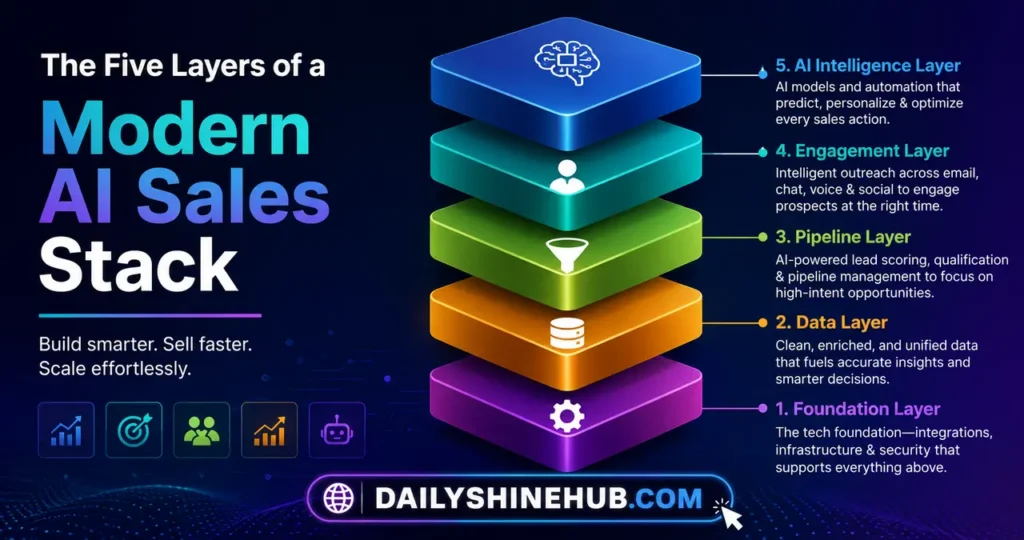
A useful way to understand the emerging GTM architecture is to divide it into five interconnected layers.
1. Customer and Revenue Data
Everything begins with reliable data.
The CRM remains one of the most important sources of customer and opportunity information. It contains account details, contacts, activities, pipeline stages, opportunities, historical interactions, and ownership information.
But CRM data alone is not enough.
Modern revenue teams also rely on:
- Firmographic data
- Intent signals
- Product usage
- Website behavior
- Conversation data
- Marketing engagement
- Customer support information
- External company signals
AI becomes significantly more useful when these data sources can be accessed together.
2. Intelligence and Enrichment
The second layer provides context.
Data enrichment platforms can add information about companies, employees, technologies, industries, locations, and other attributes.
AI can then combine these signals to create a more complete picture of an account.
Instead of asking a salesperson to manually research ten companies, an AI system can potentially summarize the relevant information and highlight which accounts deserve attention.
3. Workflow and Automation
The third layer is responsible for turning intelligence into action.
Automation platforms connect applications and execute workflows. In an AI-driven environment, these workflows can become more dynamic.
For example, instead of simply routing every inbound lead based on geography, a system could consider account size, product fit, engagement level, existing relationships, intent signals, and historical conversion data before recommending an owner.
4. AI Agents and Copilots
This is the newest major layer.
AI copilots assist people. AI agents can potentially perform tasks on their behalf.
The distinction matters.
A copilot might tell a salesperson, “This prospect mentioned implementation costs during the previous call.”
An agent could potentially retrieve that information, prepare a follow-up, update the opportunity, and schedule a task.
The degree of autonomy depends on the platform, business rules, data quality, and human approval requirements.
5. Human Decision-Making
The final layer remains human.
AI can process enormous quantities of information, but sales decisions often involve ambiguity, trust, politics, timing, emotion, and business context.
The strongest GTM organizations will therefore use AI to increase human leverage rather than blindly automate every customer interaction.
GTM Engineering Is Becoming a Strategic Revenue Function
Another major trend behind sales tech news is the emergence of GTM engineering.
GTM engineers operate at the intersection of sales, marketing, operations, data, automation, and software development. Their job is increasingly to design the infrastructure that makes revenue generation more efficient.
Research published in March 2026 found that CRM platforms such as Salesforce and HubSpot remained dominant among surveyed GTM engineers, while AI-assisted development tools such as Cursor and Claude Code were also seeing substantial adoption.
This is important because revenue teams are becoming more technically sophisticated.
Instead of waiting for a vendor to release every required feature, GTM engineers can use APIs, automation platforms, scripts, databases, and AI coding assistants to build custom internal workflows.
Why This Matters to Sales Leaders
A sales leader no longer needs to think only about hiring more representatives.
They increasingly need to ask:
- Which activities should humans perform?
- Which activities can AI handle?
- Where is our data stored?
- Can our systems communicate?
- Which workflows create measurable revenue?
- Which tools duplicate functionality?
- How quickly can we test new GTM ideas?
That makes technology architecture part of sales strategy.
Signal-Based Selling Is Replacing Generic Prospecting
Another emerging trend is the movement from list-based prospecting toward signal-based selling.
Traditional outbound prospecting often starts with a static list of companies matching an ideal customer profile.
Signal-based selling adds timing.
A company may fit the ICP but still have no reason to buy today. Another company might suddenly become highly relevant because it has hired a new executive, launched a product, expanded into a market, raised capital, changed technology providers, or demonstrated significant engagement.
AI can help revenue teams process these signals at scale.
Instead of asking:
“Who matches our target customer profile?”
the better question becomes:
“Which target customers are showing evidence that they may need us now?”
This can make outbound efforts more relevant while reducing wasted activity.
The GTM Tech Stack Is Moving Toward Fewer, Deeper Connections
The sales technology market has historically rewarded specialized tools.
Companies might purchase separate solutions for enrichment, sequencing, prospecting, intent, call intelligence, analytics, forecasting, and enablement.
But the rise of AI creates pressure for consolidation.
If every tool maintains its own customer data and AI model, organizations can end up with fragmented intelligence.
The more valuable architecture is increasingly one in which:
Data → Intelligence → AI Decision → Workflow → Human Action → Outcome Data
forms a continuous loop.
That architecture allows the system to learn from what actually happens after a recommendation or action.
A 2026 GTM engineering report similarly points toward consolidation, owned infrastructure, warehouse-native GTM systems, AI agents, and greater interoperability between tools.
Key Sales Tech Trends to Watch in 2026
| Sales Tech Trend | What Is Changing | Likely GTM Impact |
|---|---|---|
| AI Sales Agents | AI moves from recommendations toward task execution | More sales capacity without proportional headcount growth |
| Signal-Based Selling | Teams prioritize real-time buying signals | Better timing and more relevant outreach |
| GTM Engineering | Technical operators build revenue infrastructure | Faster experimentation and customized workflows |
| AI-Assisted Development | Nontraditional technical teams can build internal tools faster | Lower development barriers |
| Stack Consolidation | Companies reduce overlapping applications | Lower complexity and improved data consistency |
| Warehouse-Native GTM | Revenue workflows increasingly use centralized data infrastructure | Better control over customer intelligence |
| Agent Interoperability | AI systems need to communicate across applications | More coordinated automation |
| Human-in-the-Loop AI | People supervise important AI decisions | Better balance between efficiency and control |
Why Sales Teams Should Stop Measuring AI by Activity Alone
One of the biggest mistakes companies can make is evaluating AI based on how much work it produces.
Generating 10,000 emails is not necessarily better than generating 500 highly relevant messages.
Creating thousands of AI-generated leads does not automatically produce pipeline.
The more meaningful measurements are revenue-oriented:
- Qualified pipeline
- Conversion rates
- Sales-cycle length
- Win rate
- Revenue per representative
- Customer acquisition cost
- Pipeline velocity
- Meeting-to-opportunity conversion
- Opportunity-to-close conversion
- Forecast accuracy
The purpose of AI should ultimately be to improve these outcomes.
If an AI system saves a salesperson three hours but produces no improvement in revenue, its business value may be limited.
If another system reduces administrative work while helping representatives focus on high-value opportunities, the impact can be much greater.
The Human Layer Will Become More Valuable, Not Less
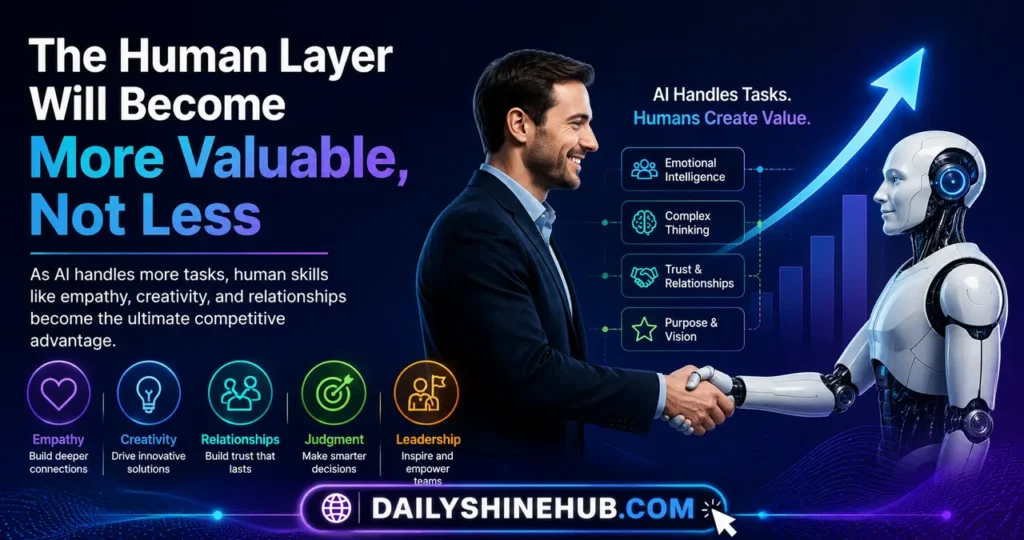
There is understandable concern that AI will replace salespeople.
The more realistic scenario is that AI will change the distribution of work within sales organizations.
Repetitive research, data entry, basic qualification, scheduling, and routine follow-ups are increasingly suitable for automation.
Complex conversations are different.
Enterprise buyers may involve procurement teams, executives, legal departments, technical stakeholders, finance leaders, and multiple internal champions. Deals can involve competing priorities and political considerations that cannot be reduced to a simple workflow.
Human sales professionals remain important because they can interpret context and build trust.
The future salesperson may therefore look less like a data-entry operator and more like an AI-augmented commercial strategist.
What an AI-First GTM Stack Should Actually Look Like
Companies should resist the temptation to purchase every new AI sales tool.
Instead, start with the revenue process.
Step 1: Map the Customer Journey
Identify how prospects move from first interaction to closed customer.
Document every major handoff.
Step 2: Find the Biggest Bottlenecks
Look for activities that consume substantial employee time without directly creating customer value.
These are often strong candidates for automation.
Step 3: Fix the Data Layer
AI cannot compensate for consistently inaccurate customer data.
Before deploying autonomous workflows, establish clear ownership, data standards, permissions, and governance.
Step 4: Introduce AI Where the Risk Is Low
Start with research, summarization, recommendations, and administrative tasks.
Once the system proves reliable, gradually expand its authority.
Step 5: Connect the Stack
An AI agent that cannot access relevant customer information or update downstream systems will have limited value.
Integration should therefore be treated as a strategic requirement rather than an afterthought.
Step 6: Measure Business Outcomes
Every AI initiative should have measurable success criteria.
Ask whether it improves productivity, pipeline quality, conversion, customer experience, or revenue.
The New Competitive Advantage: Revenue Infrastructure
The competitive advantage in sales technology is increasingly shifting from individual tools to system design.
Two companies can purchase the same CRM and AI platform but achieve very different outcomes.
Why?
Because one company may have:
- Cleaner data
- Better workflows
- Stronger sales processes
- Better integrations
- More useful customer signals
- Clear AI governance
- Better human oversight
The other may simply have more software.
That distinction is becoming increasingly important as AI capabilities become widely available.
Technology itself is becoming easier to access. The ability to design an effective revenue system is becoming more valuable.
What Sales Leaders Should Watch Next
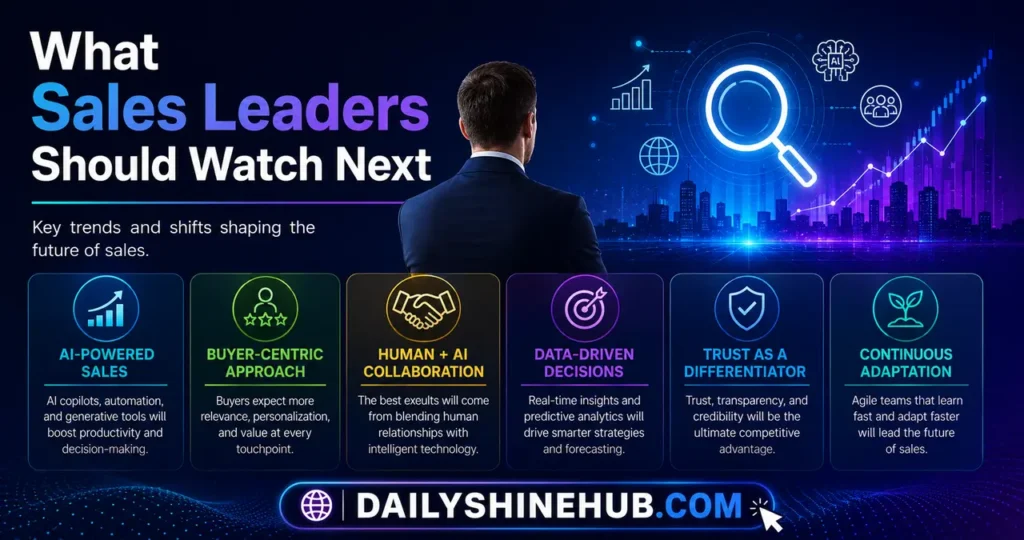
The next phase of sales technology will likely focus on greater autonomy and deeper integration.
AI agents will become more capable of completing multi-step revenue workflows. CRM systems will increasingly become AI-accessible knowledge and action layers rather than passive databases. GTM engineers will continue building custom infrastructure around commercial data. And companies will increasingly evaluate software based on revenue outcomes rather than feature counts.
There is also likely to be more pressure on vendors to prove that their AI features produce measurable business results.
The phrase “AI-powered” will not be enough.
Sales leaders will want to know:
Does it improve pipeline?
Does it increase productivity?
Does it shorten sales cycles?
Does it improve conversion?
Can we trust its decisions?
Those questions will separate useful sales technology from AI marketing hype.
Final Thoughts: The Sales Stack Is Becoming a Revenue Operating System
The most important sales tech development is not any individual AI feature.
It is the transformation of the entire GTM architecture.
Sales technology is moving from disconnected applications toward interconnected systems capable of collecting signals, interpreting data, recommending actions, executing workflows, and learning from outcomes.
For sales leaders, RevOps teams, founders, and GTM engineers, this creates both an opportunity and a challenge.
The opportunity is enormous: smaller teams can potentially accomplish more, sales representatives can spend more time with customers, and companies can respond to buying signals faster.
The challenge is equally significant. Poor data, excessive tools, weak integrations, unclear governance, and uncontrolled automation can make an AI-powered stack more complicated rather than less.
The winning strategy is therefore not to automate everything.
It is to automate intelligently, connect strategically, and keep humans focused on the decisions where human judgment creates the most value.
That is the direction sales tech is heading in 2026—and it may ultimately transform the GTM tech stack from a collection of applications into a true AI-powered revenue operating system.
FAQs About AI-Driven Sales and GTM Tech Trends
1. What is the biggest sales technology trend in 2026?
One of the biggest trends is the transition from basic automation toward AI agents capable of handling multi-step sales and GTM workflows. Instead of simply triggering predefined actions, AI systems can increasingly interpret customer information, recommend next steps, and execute selected tasks.
2. What is an AI sales agent?
An AI sales agent is software designed to perform sales-related tasks using artificial intelligence. Depending on its capabilities and permissions, it may conduct research, identify prospects, qualify leads, create outreach, summarize interactions, update CRM records, or coordinate workflows.
3. Will AI replace sales representatives?
AI is more likely to change sales roles than eliminate the need for salespeople entirely. Routine administrative and research tasks are increasingly automatable, while complex discovery, negotiation, relationship management, and strategic selling still benefit heavily from human judgment.
4. What is GTM engineering?
GTM engineering is the practice of building and managing the technical systems that support go-to-market operations. GTM engineers can work across CRM architecture, data, APIs, automation, enrichment, AI agents, workflows, and internal revenue tools. The role is becoming increasingly important as sales organizations become more technical.
5. How should companies build an AI-ready sales tech stack?
Companies should begin with their revenue process rather than individual AI products. They should establish reliable customer data, identify repetitive bottlenecks, connect core systems, introduce AI gradually, maintain human oversight for important decisions, and measure AI initiatives against revenue outcomes such as conversion, pipeline quality, sales productivity, and win rate.
To explore how similar AI-driven intelligence is transforming other areas of physical and corporate operations, check out our detailed guide on Spot AI and video intelligence.

Ethan Shine is a passionate content strategist, tech enthusiast, and digital media contributor at DailyShineHub. With over 5 years of experience in blogging and search engine optimization, Ethan specializes in breaking down complex topics into clear, actionable insights. When he isn’t researching the latest industry trends, he enjoys exploring global news, digital tools, and modern lifestyle concepts.