
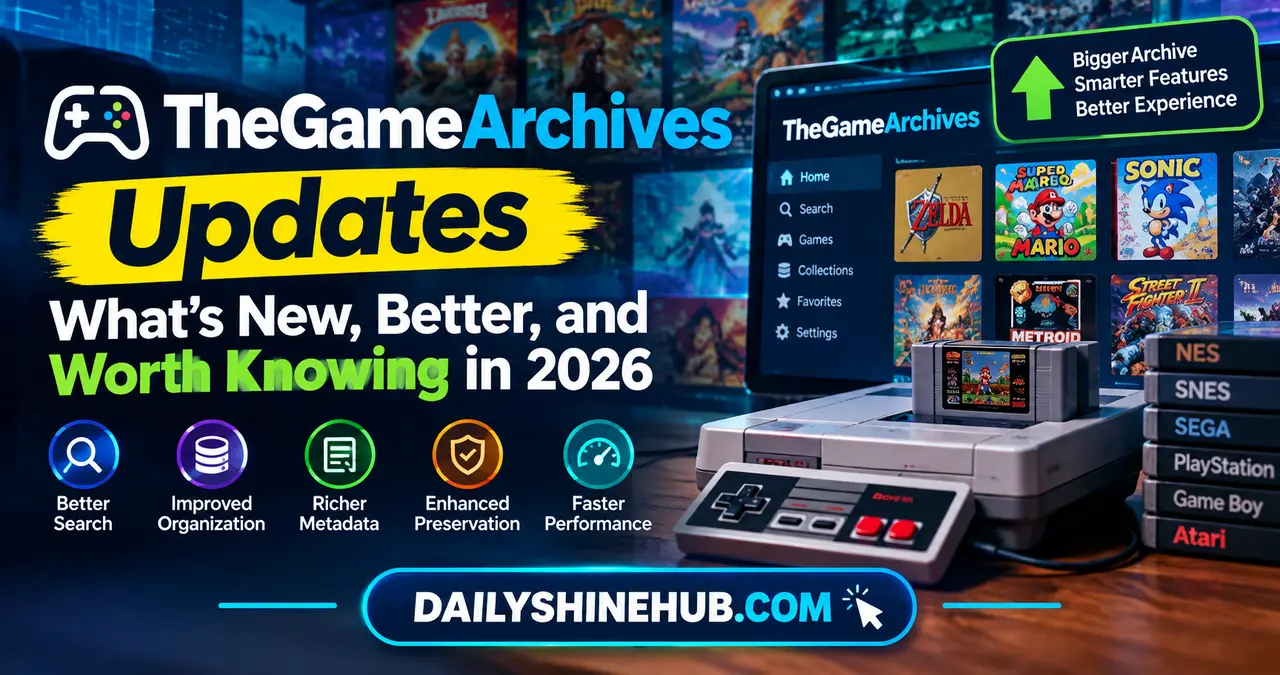
TheGameArchives Updates have become increasingly relevant for retro gamers, collectors, researchers, and anyone interested in preserving older video game history. The platform is associated with an archive-focused approach to classic gaming, where titles, metadata, platform information, guides, and preservation resources can be organized for easier discovery. Recent material connected with TheGameArchives describes improvements involving search, catalog organization, performance, metadata, and preservation workflows.
For players, the value of these changes is not simply about finding an old game faster. Good archival systems can make it easier to identify a particular release, understand its platform and region, distinguish versions, and preserve useful information for future generations. That matters because older games can become difficult to access as hardware, storage formats, operating systems, and online services become obsolete.
| Key Detail | What It Means |
|---|---|
| Primary focus | Classic games and gaming preservation |
| Major update themes | Search, organization, metadata, performance, and usability |
| Useful for | Retro gamers, collectors, researchers, preservation enthusiasts |
| Discovery tools | Search and category/filter-based browsing |
| Preservation focus | Game files, documentation, metadata, versions, and historical information |
| Important consideration | Copyright and licensing should always be checked |
| Current relevance | 2026 archive and gaming updates |
What TheGameArchives Updates Actually Mean
The phrase TheGameArchives Updates can refer to changes involving the archive platform itself rather than ordinary patch notes for a particular video game. That distinction is important because users may otherwise expect information about character balancing, new maps, downloadable content, or multiplayer fixes.
Recent reporting about the platform describes several areas of improvement:
- Database and catalog organization
- Search accuracy and indexing
- Metadata and version information
- Website performance
- Mobile usability
- Archive verification
- Preservation-oriented documentation
- Easier discovery of older and harder-to-find titles
A February 2026 report specifically describes a structured upgrade involving database restructuring, refined search, and performance and security optimization. Meanwhile, more recent TheGameArchives material describes features such as platform filters, release-date information, regional versions, checksums, and newly verified entries.
TheGameArchives Updates and Better Game Discovery
One of the most practical reasons to follow TheGameArchives Updates is improved discovery. A large archive becomes less useful when users cannot quickly locate the exact title or version they remember.
Search improvements can make a noticeable difference when a game has:
- Multiple regional releases
- Different platform versions
- Alternate spellings
- Several revisions
- Beta or prototype builds
- Different release years
- Related series entries
According to current material describing TheGameArchives, its search system is designed around title, platform, year, developer, region, and related metadata. The archive also describes support for alternate spellings and version-oriented discovery.
For a retro gamer, that means searching only by a familiar title may no longer be the best approach. Adding the console, release period, region, or developer can help narrow results.
Practical Search Tips
When using an archive-style gaming database, try:
- Searching the exact game title first.
- Adding the original console or computer platform.
- Checking regional versions if the first result does not match.
- Comparing release dates and developer information.
- Looking at screenshots or metadata before identifying a version.
- Checking revision or checksum information where available.
This approach is especially useful for collectors who want to distinguish between releases rather than simply find the first matching title.
TheGameArchives Updates and Archive Organization
Another important area associated with TheGameArchives Updates is organization. A large collection needs more than a list of game names. Useful metadata provides context about what a particular item actually represents.
TheGameArchives material describes information such as:
- Platform
- Release date
- Region
- Developer
- Game version
- File information
- Screenshots
- Controller requirements
- Community notes
- Preservation information
This kind of structure can turn a simple collection into a more useful research resource. Someone investigating the history of a franchise, for example, may want to compare regional releases or understand how a title changed between platforms.
The broader importance of this work is supported by established preservation institutions. The Library of Congress identifies software and video games as preservation materials and recommends maintaining appropriate source, master, distribution, operating-system, platform, and related documentation where possible.
Why Video Game Preservation Matters
The importance of TheGameArchives Updates becomes clearer when viewed within the wider problem of video game preservation.
Unlike a traditional book, a video game can depend on several layers of technology. The software may require a particular operating system, console, controller, graphics system, server, or other external component. When one of those components disappears, simply owning the original game may not be enough to reproduce the original experience.
The Library of Congress explains that video games create unique acquisition, description, and preservation challenges. Its National Audio-Visual Conservation Center has preserved thousands of video games across formats ranging from floppy disks to modern cartridges.
For additional background, the broader subject of video game preservation explains why aging hardware, deteriorating media, proprietary technology, and unavailable source material can create long-term preservation problems.
What Can Disappear?
Classic gaming material can become difficult to preserve because of:
- Aging cartridges, disks, and optical media
- Hardware failures
- Unsupported operating systems
- Closed digital storefronts
- Lost development materials
- Licensing restrictions
- Missing servers or online dependencies
- Companies shutting down
- Incomplete documentation
That is why archive updates should not be judged only by appearance. Better metadata, indexing, verification, and documentation can be just as important as a redesigned interface.
TheGameArchives Updates and Metadata Improvements
Metadata is one of the less visible but more important parts of TheGameArchives Updates. When a game is properly described, users can understand what they are looking at before spending time investigating it.
Useful metadata might include:
- Original release year
- Developer and publisher
- Supported platform
- Region
- Language
- Version or revision
- File format
- Documentation
- Compatibility information
- Preservation notes
This is particularly valuable for obscure games. A well-known title may be easy to identify, but an obscure regional release or prototype can be much harder to distinguish from similar entries.
The Library of Congress’s current recommended formats for software and video games also emphasize documentation and associated materials, showing that preservation involves considerably more than keeping a single executable file.
TheGameArchives Updates for Retro Gamers
For everyday retro players, TheGameArchives Updates can be useful because they improve the process of finding information about older games. Instead of relying entirely on memories, scattered forum posts, or incomplete database entries, users can compare structured information.
Retro gamers can benefit from these improvements by:
- Finding games from a particular console generation.
- Exploring forgotten releases from a favorite developer.
- Comparing regional editions.
- Researching older franchises.
- Identifying versions before using an emulator.
- Learning about historical gaming hardware.
- Building a more organized personal collection.
The archive concept also makes retro gaming more approachable for younger players. Someone who never experienced an older console can use organized information to understand what games were released, when they appeared, and how they fit into gaming history.
Technical and Performance Improvements
Website performance is another practical part of TheGameArchives Updates. Archive websites can contain large amounts of metadata, images, search indexes, and downloadable information. If pages load slowly or search results are poorly organized, even a large collection can become frustrating to use.
Recent material connected with TheGameArchives describes performance optimization alongside search and database improvements.
For users, technical improvements may translate into:
- Faster page loading
- More responsive searches
- Better mobile browsing
- Improved indexing
- More consistent navigation
- Easier access to game information
These changes may seem small individually, but together they can make a large archive significantly easier to navigate.
How to Use TheGameArchives More Effectively
Getting the most from TheGameArchives Updates requires a little more than typing a game name into a search box. A systematic approach can help users avoid confusion between versions and releases.
A Simple Workflow
- Start with the title: Search for the exact game name.
- Confirm the platform: Check whether the entry corresponds to the console or computer you remember.
- Check the release date: Similar titles may have been released years apart.
- Review region information: North American, European, Japanese, and other releases may differ.
- Compare versions: Look for revisions, builds, or regional differences.
- Read documentation: Manuals, notes, and metadata can clarify unusual entries.
- Verify legal status: Copyright and licensing can vary by country and title.
- Use trusted technical information: Do not assume that every file or compatibility claim is automatically authoritative.
This workflow is useful whether you are researching a game for historical reasons or simply trying to identify an old favorite.
Legal and Responsible Use
Preservation and access are closely connected to copyright. A game being old does not automatically mean that it is public domain or free of copyright restrictions.
Users should therefore pay attention to:
- Copyright status
- Licensing information
- Regional laws
- Rights-holder notices
- Archive policies
- Distribution permissions
- Emulator requirements
The Library of Congress notes that rights assessment remains important when preserving or distributing protected material.
Responsible retro gaming means separating the legitimate goal of learning about gaming history from assumptions about whether a particular file can legally be downloaded, copied, modified, or redistributed.
What Could Come Next?
Future TheGameArchives Updates could continue moving toward better organization, stronger metadata, improved compatibility information, and more detailed preservation records. The exact direction of future development should be confirmed through the platform’s own announcements rather than assumed.
Several areas would be particularly useful for archive users:
- More detailed version histories
- Better regional comparisons
- Stronger metadata standards
- Improved mobile interfaces
- Better documentation of obscure releases
- More preservation-focused technical notes
- Easier ways to identify incomplete or uncertain entries
These features would benefit both casual players and researchers because they improve the reliability and discoverability of historical gaming information.
Key Takeaways From TheGameArchives Updates
The most important points can be summarized simply:
- TheGameArchives Updates focus on the archive experience rather than ordinary game patch notes.
- Search and indexing are important improvements for large collections.
- Metadata helps users distinguish different versions and regional releases.
- Preservation requires more than storing game files.
- Operating systems, hardware, documentation, and external dependencies can all matter.
- Copyright and licensing should be considered before downloading or redistributing material.
- Retro gaming archives can serve players, collectors, historians, and researchers.
- Future changes should be checked against current platform information before being treated as confirmed.
Conclusion: Why TheGameArchives Updates Matter
TheGameArchives Updates reflect a broader change in how gamers think about older video games. Retro titles are not simply entertainment from another era; they are also pieces of technological and cultural history. Better search, organization, metadata, performance, and preservation practices can make that history easier to discover and study.
For players, the biggest practical benefit is easier navigation through older gaming material. For collectors and researchers, structured metadata and version information can provide valuable context. And for preservation enthusiasts, improvements to documentation and archive organization contribute to the larger goal of keeping gaming history accessible.
The most responsible approach is to use archive information carefully, verify versions and metadata, and respect copyright and licensing requirements. With those principles in mind, TheGameArchives Updates can be understood as part of the continuing effort to make classic gaming information easier to discover and preserve.
Related: Read our detailed guide on Gaming Tips PBLinuxTech: 15 Smart Linux Gaming Tips for Better Performance
FAQs
1. What are TheGameArchives Updates?
TheGameArchives Updates generally refer to improvements and changes involving the archive platform, including search, organization, metadata, usability, performance, and preservation-related features.
2. Is TheGameArchives only for retro gamers?
Not necessarily. Although classic and hard-to-find games are a major focus, archive resources can also be useful to collectors, researchers, gaming historians, and people interested in the development of video games.
3. What information should I check before identifying an archived game?
Check the title, platform, release date, region, developer, version, language, screenshots, and available metadata. These details can help distinguish similar releases.
4. Does an old game automatically become legal to download?
No. Age alone does not determine copyright status. Users should check applicable copyright law, licensing information, rights-holder policies, and the specific circumstances surrounding a game.
5. Why are updates important for a gaming archive?
Regular improvements can make large collections easier to search and understand. Better indexing, metadata, verification, documentation, and technical performance can all improve long-term accessibility.
DailyShineHUb

Ethan Shine is a passionate content strategist, tech enthusiast, and digital media contributor at DailyShineHub. With over 5 years of experience in blogging and search engine optimization, Ethan specializes in breaking down complex topics into clear, actionable insights. When he isn’t researching the latest industry trends, he enjoys exploring global news, digital tools, and modern lifestyle concepts.