
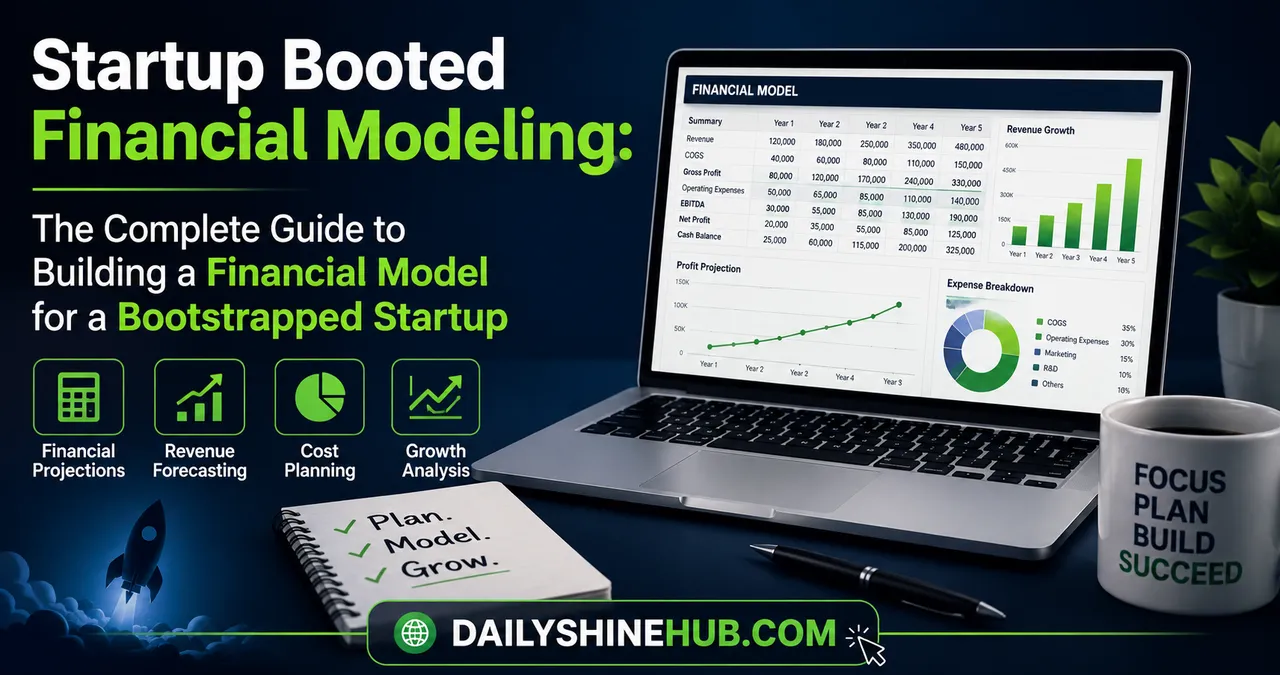
Building a financial model for a bootstrapped startup is different from modeling a venture-backed company.
A bootstrapped founder cannot assume that the next funding round will solve a cash shortage, cover inefficient spending, or finance years of unprofitable growth. Every major decision must be connected to revenue, expenses, cash flow, runway, and sustainable profitability.
That is why startup booted financial modeling should focus on one central question:
Can the business grow while maintaining enough cash to survive and eventually become sustainably profitable?
A useful financial model does not need to predict the future perfectly. Instead, it should help founders understand how different decisions affect the company’s financial position.
This guide explains how to build a practical financial model for a bootstrapped startup, including revenue forecasting, operating expenses, cash flow, runway, break-even analysis, scenario planning, and investor-ready projections.
What Is Startup Booted Financial Modeling?
Startup booted financial modeling refers to creating a structured financial forecast for a startup that is primarily funded through founder capital, customer revenue, or internally generated cash rather than repeated external investment.
In corporate finance, standard financial modeling provides a quantitative representation of a company’s financial performance. For a bootstrapped business, however, the model must be tailored specifically to track liquidity, cash burn, and organic reinvestment.
The model typically connects:
- Revenue
- Cost of goods sold
- Gross profit
- Operating expenses
- Payroll
- Marketing
- Technology costs
- Cash inflows
- Cash outflows
- Monthly burn
- Cash balance
- Runway
- Break-even point
- Profitability
- Growth assumptions
For a bootstrapped business, the model should be practical enough to support real decisions.
For example, if a founder wants to hire two employees, the model should show how the additional payroll affects monthly cash burn and how much additional revenue would be required to justify the hiring.
Likewise, if the company plans to increase advertising spending, the model should estimate the additional customers required to make that investment worthwhile.
The goal is not simply to create impressive financial statements.
The goal is to create a decision-making system.
Why Bootstrapped Startups Need a Different Financial Model
A conventional startup financial model may emphasize market expansion, aggressive customer acquisition, fundraising requirements, and long-term valuation.
A bootstrapped model places greater emphasis on financial control.
When structuring complex funding contracts, debt agreements, or owner equity distributions, founders often consult a finance lawyer to ensure legal compliance and avoid costly structural pitfalls.
The founder needs to know:
- How much cash is available today?
- How much revenue is expected each month?
- What expenses are essential?
- Which expenses can be delayed?
- How quickly is cash being consumed?
- How long can the company operate without additional capital?
- When will the company reach break-even?
- What happens if revenue grows slower than expected?
- How much can the founder safely spend on hiring and marketing?
This makes cash flow particularly important.
A startup can report accounting revenue while still experiencing serious cash pressure. For example, customers may receive payment terms of 30 or 60 days while employees, suppliers, software vendors, and advertising platforms require immediate payment.
Therefore, bootstrapped financial modeling should track both profitability and liquidity.
Start With the Model’s Core Assumptions
Before entering numbers into a spreadsheet, define the assumptions that drive the business.
These assumptions should be realistic, measurable, and easy to change.
For B2B startups, customer acquisition assumptions can also include lower-cost channels such as executive networking, referrals, partnerships, and industry communities. Networks such as The Millennium Alliance can be considered alongside paid marketing when evaluating relationship-driven customer acquisition channels.
Typical assumptions include:
- Average selling price
- Number of customers
- New customers per month
- Customer retention
- Churn rate
- Conversion rate
- Customer acquisition cost
- Gross margin
- Employee salaries
- Contractor costs
- Marketing budget
- Software expenses
- Payment processing fees
- Taxes
- Founder compensation
- Payment collection timing
Separate assumptions from calculations.
For example, instead of manually entering revenue into every month, create assumptions for customers and average revenue per customer.
Then calculate:
Revenue = Number of Customers × Average Revenue per Customer
This makes the model easier to update when business conditions change.
Build the Revenue Forecast
Revenue forecasting is usually the most important section of a startup financial model.
However, founders should avoid simply saying:
“Revenue will grow 20% every month.”
A better approach is to build revenue from operational drivers.
SaaS Revenue Forecast
For a subscription startup, you might model:
Ending Customers = Beginning Customers + New Customers − Churned Customers
Then:
Revenue = Average Customers × Average Monthly Revenue per Customer
For example, if the startup begins with 100 customers, adds 25 customers, loses 5 customers, and generates an average of $50 per customer per month:
Ending Customers = 100 + 25 − 5 = 120
The revenue forecast can then be connected to the customer base.
Service Business Revenue Forecast
A service company may use a different driver.
For example:
Revenue = Number of Projects × Average Project Value
Or:
Revenue = Billable Hours × Hourly Rate
This approach is more useful than applying an arbitrary growth percentage because it reflects the actual operating mechanics of the business.
E-Commerce Revenue Forecast
An e-commerce startup could model:
Revenue = Website Visitors × Conversion Rate × Average Order Value
This allows the founder to understand what must improve to increase revenue.
If traffic stays constant, improving conversion may increase sales.
If conversion remains stable, increasing qualified traffic may become the growth lever.
Separate New Revenue From Existing Revenue
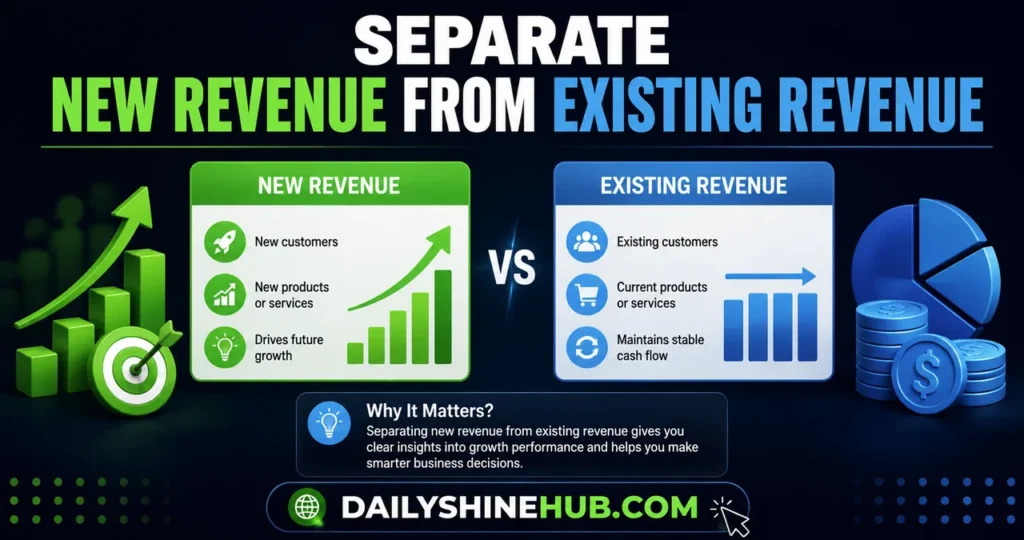
A strong startup model should distinguish between revenue generated from existing customers and revenue generated from new customers.
This is especially important for recurring-revenue businesses.
You can model:
- Beginning recurring revenue
- Expansion revenue
- New customer revenue
- Churned revenue
- Downgrade revenue
- Ending recurring revenue
This helps founders identify whether growth comes from customer acquisition, retention, or expansion.
A business with strong acquisition but high churn may appear to grow while continuously replacing lost customers.
The financial model should make this visible.
Model Customer Acquisition Economics
Revenue forecasting becomes more useful when it connects to customer acquisition.
Important metrics include:
Customer Acquisition Cost (CAC)
CAC = Sales and Marketing Spend ÷ Number of New Customers
Suppose a startup spends $10,000 on sales and marketing and acquires 200 customers.
CAC would be:
$10,000 ÷ 200 = $50
The founder can then compare CAC with customer lifetime value.
If customers generate very little gross profit, spending heavily to acquire them may create a cash-flow problem.
Calculate Customer Lifetime Value
Customer lifetime value, or LTV, estimates the economic value generated by a customer over the expected relationship.
A simplified recurring-revenue formula is:
LTV ≈ Average Revenue per Customer × Gross Margin ÷ Monthly Churn Rate
The exact formula can vary depending on the business model.
For a bootstrapped startup, LTV should not be treated as an excuse to spend aggressively.
The important question is:
How quickly does the company recover its customer acquisition cost?
That leads to the concept of CAC payback.
CAC Payback Period
CAC payback estimates how long it takes to recover the cost of acquiring a customer.
A simplified formula is:
CAC Payback Period = CAC ÷ Monthly Gross Profit per Customer
If CAC is $300 and monthly gross profit per customer is $50:
CAC Payback = 6 months
A shorter payback period can be particularly valuable for bootstrapped companies because it allows growth spending to recycle into additional growth faster.
Build the Expense Model
After forecasting revenue, build the expense structure.
Expenses should generally be divided into:
Cost of Goods Sold
COGS represents costs directly associated with delivering the product or service.
Depending on the startup, this might include:
- Hosting
- Manufacturing
- Packaging
- Fulfillment
- Payment processing
- Direct labor
- Third-party infrastructure
- Supplier costs
Then calculate:
Gross Profit = Revenue − COGS
And:
Gross Margin = Gross Profit ÷ Revenue
Gross margin is one of the most important metrics in the model because it determines how much revenue remains available to cover operating expenses.
Operating Expenses
Operating expenses may include:
- Salaries
- Contractor payments
- Rent
- Software
- Accounting
- Legal services
- Insurance
- Marketing
- Sales expenses
- Travel
- Administrative costs
- Customer support
- Equipment
Separate fixed expenses from variable expenses whenever possible.
Fixed expenses remain relatively stable as revenue changes.
Variable expenses increase or decrease with business activity.
This distinction becomes important when calculating break-even.
Model Payroll Carefully
Payroll can become the largest expense in a growing startup.
Do not model employees simply as a single annual salary number.
Include:
- Base salary
- Employer taxes
- Benefits
- Bonuses
- Commissions
- Recruitment costs
- Equipment
- Payroll processing costs
A $60,000 annual salary does not necessarily mean the company’s total annual employment cost is exactly $60,000.
For a bootstrapped startup, hiring should be connected to a measurable business requirement.
For example:
New Hire → Additional Capacity → Additional Revenue or Cost Savings
If that connection is unclear, the founder should test the hiring decision through multiple scenarios.
Create a Monthly Cash Flow Forecast

Cash flow is the heart of a bootstrapped startup financial model.
The basic structure is:
Beginning Cash + Cash Inflows − Cash Outflows = Ending Cash
Cash inflows can include:
- Customer payments
- Founder contributions
- Loans
- Grants
- Other operating receipts
Cash outflows can include:
- Payroll
- Rent
- Software
- Advertising
- Supplier payments
- Taxes
- Equipment
- Loan repayments
- Other operating expenses
The model should calculate ending cash for every month.
A 12-month or 24-month monthly forecast is often more useful than a single annual total because cash shortages can occur even when annual numbers look acceptable.
Understand Burn Rate
Burn rate measures how quickly a startup consumes cash.
A simple calculation is:
Monthly Net Burn = Cash Outflows − Cash Inflows
If the startup spends $30,000 and receives $20,000 during a month:
Net Burn = $10,000
If revenue increases to $25,000 while expenses remain $30,000:
Net Burn = $5,000
The company is still losing cash, but its financial position is improving.
Gross Burn vs. Net Burn
Gross burn represents total cash operating expenses.
Net burn considers cash generated by the business.
For example:
- Operating expenses: $40,000
- Customer cash collections: $25,000
Gross burn = $40,000
Net burn = $15,000
Both figures can be useful, but founders should pay close attention to net burn when evaluating runway.
Calculate Startup Runway
Runway estimates how long the startup can continue operating before its cash is exhausted.
A simplified formula is:
Runway = Cash Available ÷ Monthly Net Burn
Suppose the startup has $120,000 in cash and burns $20,000 per month.
Runway = 120,000 ÷ 20,000 = 6 months
However, this simple calculation assumes burn remains constant.
A more accurate financial model calculates the projected ending cash balance month by month.
This matters because revenue and expenses usually change over time.
If the startup is growing revenue rapidly, runway may increase even if expenses are rising.
If revenue falls, runway may shrink quickly.
Add a Minimum Cash Threshold
A smart bootstrapped model should not assume that the company can safely operate until the bank balance reaches zero.
Set a minimum cash reserve.
For example:
Minimum Cash Reserve = 3–6 Months of Essential Operating Expenses
The exact amount depends on the business.
When projected cash falls below that threshold, the model should trigger a warning.
Possible actions include:
- Reduce discretionary spending
- Delay hiring
- Reduce marketing
- Increase prices
- Improve collections
- Negotiate supplier terms
- Increase sales activity
- Seek financing
- Adjust the business model
This turns the spreadsheet into an early-warning system.
Perform Break-Even Analysis
Break-even analysis determines when revenue is sufficient to cover costs.
The basic formula is:
Break-Even Revenue = Fixed Costs ÷ Contribution Margin
Suppose fixed costs are $30,000 per month and the contribution margin is 60%.
Break-even revenue would be:
$30,000 ÷ 0.60 = $50,000
The startup would need approximately $50,000 in monthly revenue to cover its fixed costs under those assumptions.
Break-Even Customers
You can also calculate the number of customers required to break even.
Break-Even Customers = Fixed Costs ÷ Contribution Margin per Customer
If monthly fixed costs are $30,000 and each customer contributes $100 toward fixed costs:
Break-Even Customers = 300
This gives founders a concrete operational target.
Use the Model to Test Pricing

Financial modeling can help answer one of the most important startup questions:
What should we charge?
Create several pricing scenarios.
For example:
- $29/month
- $49/month
- $79/month
Then model:
- Conversion rate
- Customer volume
- Gross margin
- Churn
- Revenue
- Cash flow
- Break-even date
A higher price may reduce customer volume but increase revenue per customer.
A lower price may increase conversion but require significantly more customers.
The best pricing decision is therefore not always the option with the highest number of customers.
It is the option that produces a healthy combination of demand, margin, retention, and cash generation.
Build Three Financial Scenarios
A bootstrapped startup should never rely on one forecast.
Build at least three:
Base Case
The base case represents the most realistic expected outcome.
It should use reasonable assumptions rather than optimistic targets.
Downside Case
The downside case assumes weaker performance.
For example:
- Lower customer acquisition
- Higher churn
- Slower revenue growth
- Higher expenses
- Delayed payments
- Lower conversion
The purpose is to answer:
Can the company survive if things go worse than expected?
Upside Case
The upside case assumes stronger performance.
For example:
- Higher conversion
- Lower churn
- Faster customer acquisition
- Improved pricing
- Better margins
The upside case should still be credible.
It should not simply represent unrealistic exponential growth.
Key Financial Model Structure
A practical bootstrapped startup model can be organized like this:
| Financial Section | Key Inputs | Important Outputs |
|---|---|---|
| Revenue | Customers, pricing, conversion, retention | Monthly revenue, MRR/ARR |
| COGS | Hosting, production, fulfillment | Gross profit, gross margin |
| Payroll | Employees, salaries, benefits | Total people cost |
| Operating Expenses | Marketing, software, rent, services | Operating expenses |
| Cash Flow | Collections and payments | Net cash flow |
| Runway | Cash balance and burn | Months of runway |
| Break-Even | Fixed costs and contribution margin | Break-even revenue/customers |
| Scenarios | Growth, churn, pricing, expenses | Base, downside, upside outcomes |
This structure keeps the model understandable while allowing different assumptions to flow through the entire forecast.
Track Accounts Receivable and Payment Timing
Profit does not always equal cash.
Suppose a startup records $50,000 of revenue in January but customers do not pay until February.
The income statement may show $50,000 of January revenue.
The cash-flow statement may show little or none of that cash arriving in January.
This difference can become dangerous for bootstrapped companies.
Model:
- Invoice timing
- Collection timing
- Payment terms
- Accounts receivable
- Supplier payment timing
- Payroll dates
- Tax payment dates
Cash timing can be just as important as revenue growth.
Include Taxes and One-Time Expenses
Many early-stage models underestimate taxes and irregular costs.
Potential expenses include:
- Corporate taxes
- Payroll taxes
- Sales taxes
- Professional fees
- Insurance renewals
- Annual software subscriptions
- Equipment purchases
- Legal expenses
- Website development
- Recruiting costs
One-time expenses should not disappear simply because they do not occur every month.
Create a separate section for them.
This prevents unexpected expenses from damaging the cash forecast.
Create an Investor-Ready Projection

Even if a startup is currently bootstrapped, it may eventually seek outside funding.
A well-built model should therefore be easy for another person to understand.
An investor-ready model should clearly show:
- Revenue growth
- Gross margin
- Operating expenses
- EBITDA or operating profit
- Cash flow
- Cash balance
- Customer growth
- CAC
- LTV
- Churn
- Headcount
- Break-even timing
- Capital requirements
The objective is not to make the numbers look perfect.
Credibility matters more than unrealistic growth.
Investors and lenders generally want to understand the assumptions behind the forecast.
Add a Dashboard for Decision-Making
A financial model becomes much more useful when the most important metrics are visible on a dashboard.
Consider tracking:
Revenue
Gross Margin
Monthly Recurring Revenue
Customer Count
CAC
Churn
Monthly Burn
Cash Balance
Runway
Break-Even Date
Operating Profit
The dashboard should make changes obvious.
If runway falls from 12 months to 7 months, the founder should be able to identify that immediately.
Common Financial Modeling Mistakes
Using Unrealistic Growth Rates
A forecast that assumes revenue doubles every month may look impressive but provides little strategic value.
Use operating drivers instead.
Ignoring Cash Flow
A profitable business can still fail if it cannot pay its bills on time.
Cash must be modeled separately.
Underestimating Expenses
Founders often remember salaries and rent but forget software, taxes, professional services, payment fees, insurance, equipment, and other costs.
Mixing Assumptions With Formulas
Hardcoding numbers throughout the spreadsheet makes the model difficult to update.
Keep assumptions centralized.
Building Only One Scenario
A single forecast hides risk.
Always test downside conditions.
Treating the Model as a One-Time Project
A startup financial model should evolve as real data becomes available.
Actual results should be compared with forecasts regularly.
How Often Should You Update a Bootstrapped Financial Model?
For an early-stage startup, monthly updates are usually practical.
At the end of each month:
- Enter actual revenue.
- Enter actual expenses.
- Update customer numbers.
- Update cash balances.
- Compare actual results with forecasts.
- Identify major variances.
- Adjust assumptions.
- Recalculate runway.
- Review the break-even timeline.
- Update future projections.
The goal is not to constantly change the forecast to make it look accurate.
The goal is to learn from actual business performance.
Use Variance Analysis to Improve Decisions
Variance analysis compares actual performance with projected performance.
For example:
Projected Revenue: $40,000
Actual Revenue: $34,000
Variance: −$6,000
The next question is why.
Possible reasons include:
- Fewer customers
- Lower conversion
- Lower average order value
- Higher churn
- Delayed contracts
- Seasonal demand
The same approach should be applied to expenses.
If marketing costs are 30% above forecast, investigate the reason before simply increasing the forecast.
The Best Financial Model Is a Decision Tool

The biggest mistake founders can make is treating financial modeling as an accounting exercise.
A strong model should help answer practical questions.
Can we hire this employee?
Can we afford this marketing campaign?
Should we increase prices?
How much cash should we keep in reserve?
When will we reach break-even?
What happens if sales fall by 20%?
How much revenue do we need to support our current team?
Can we survive without external funding?
When the model answers these questions clearly, it becomes one of the most valuable management tools in the business.
Final Thoughts on Startup Booted Financial Modeling
Effective startup booted financial modeling is ultimately about financial visibility.
A bootstrapped startup does not have the luxury of ignoring cash flow or assuming future funding will solve today’s problems. The financial model must connect business activity to financial outcomes.
Start with realistic revenue drivers.
Model expenses in detail.
Separate fixed and variable costs.
Track gross margin.
Forecast monthly cash flow.
Calculate burn and runway.
Determine the break-even point.
Test downside scenarios.
Update the model using actual results.
Most importantly, use the model to make better decisions.
A financial model does not guarantee that a startup will succeed. But a well-designed model can reveal financial problems earlier, identify opportunities more clearly, and give founders a much stronger understanding of what it takes to build a sustainable company.
FAQs About Startup Booted Financial Modeling
1. What should a bootstrapped startup financial model include?
A practical model should include revenue forecasting, COGS, gross profit, operating expenses, payroll, cash flow, cash balance, burn rate, runway, break-even analysis, customer metrics, and multiple scenarios.
2. How many years should a bootstrapped startup financial model forecast?
A 24- to 36-month forecast can provide useful long-term visibility, while the first 12 months should generally receive the most detailed monthly attention. The appropriate horizon depends on the startup’s business model and planning needs.
3. What is the most important metric for a bootstrapped startup?
Cash balance and runway are particularly important because a bootstrapped company has limited access to external capital. However, revenue growth, gross margin, CAC, retention, and profitability should also be monitored together.
4. How can a startup calculate its break-even point?
A basic formula is Break-Even Revenue = Fixed Costs ÷ Contribution Margin. The result estimates the revenue level required to cover fixed costs under the model’s assumptions.
5. Should a bootstrapped startup create an investor-ready financial model?
Yes. Even if fundraising is not currently planned, an investor-ready model can improve financial planning, demonstrate business sustainability, identify capital requirements, and make future financing discussions easier.

Ethan Shine is a passionate content strategist, tech enthusiast, and digital media contributor at DailyShineHub. With over 5 years of experience in blogging and search engine optimization, Ethan specializes in breaking down complex topics into clear, actionable insights. When he isn’t researching the latest industry trends, he enjoys exploring global news, digital tools, and modern lifestyle concepts.