
Building a startup without outside funding can be one of the most demanding—and rewarding—ways to create a business.
A bootstrapped founder typically starts with personal savings, early customer revenue, freelance income, or money generated directly by the company.
This approach gives founders something many venture-backed entrepreneurs eventually have to negotiate for: control.
But bootstrapping can also create a difficult growth problem.
A startup may have strong customer demand, a proven product, and a clear path to expansion, yet lack enough capital to hire employees, develop technology, enter new markets, or increase marketing.
That is where a carefully designed startup booted fundraising strategy can make a major difference.
The goal is not necessarily to raise as much money as possible.
The smarter objective is to raise the right amount of capital, from the right sources, under terms that preserve meaningful founder control.
For bootstrapped companies, fundraising should be viewed as a strategic tool rather than a finish line.
Instead of immediately pursuing a large venture-capital round, founders can consider revenue-based financing, strategic investors, crowdfunding, customer-funded growth, angel investment, grants, or smaller equity rounds.
The best approach depends on the startup’s revenue, growth rate, industry, capital requirements, and long-term ambitions.
This guide explains how bootstrapped founders can raise capital while protecting ownership, decision-making authority, and the culture they worked to build.
What a Startup Booted Fundraising Strategy Really Means
A startup booted fundraising strategy is a capital-raising approach designed around a business that has primarily grown through internal resources rather than traditional venture funding.
The phrase is often associated with businesses that have already demonstrated some level of market validation.
That distinction matters.
A bootstrapped startup may have paying customers, recurring revenue, profitable operations, strong retention, or an established niche.
These characteristics can put the founder in a stronger negotiating position than an entrepreneur seeking money before proving the business model.
To build an effective strategy, founders should utilize structured startup booted financial modeling to determine how much capital they need, when they may need it, and which financing option best fits their business.
The strategy therefore focuses on three questions:
- How much capital does the company actually need?
- What type of capital creates the least unnecessary dilution or control risk?
- What investor or financing structure supports the founder’s long-term vision?
The answer is rarely simply to “raise a large VC round.” Founders should first compare non-dilutive funding, customer-funded growth, angel investment, strategic partnerships, and other financing options.
Why Bootstrapped Founders Want Capital Without Giving Up Control
Outside capital can accelerate growth, but it can also change the balance of power inside a company.
When founders sell equity, they give investors a percentage of ownership. Depending on the deal structure, investors may also receive board representation, voting rights, information rights, veto rights, liquidation preferences, or other protections.
None of these terms are automatically bad, but entering complex financial agreements without professional legal oversight can be risky. Consulting an experienced finance lawyer before signing investment terms or debt agreements ensures your rights and operational freedom remain fully protected.
The core problem occurs when founders accept restrictive terms without understanding their long-term consequences. A founder who owns 80% of a company before fundraising might own considerably less after multiple financing rounds.
More importantly, ownership percentage and control are not always identical. A founder could retain a substantial economic stake while losing practical influence over important decisions.
Start With the Capital You Actually Need
One of the biggest mistakes founders make is deciding how much money to raise before determining what the capital needs to accomplish.
A better method starts with specific business milestones.
For example, a startup might need $500,000 to:
- Hire three key employees.
- Improve its product infrastructure.
- Expand sales operations.
- Enter one additional market.
- Reach a specific annual recurring revenue target.
The fundraising target should then be connected to those milestones.
This creates a more disciplined capital strategy.
Instead of saying, “We want $2 million to grow faster,” the founder can explain exactly what $500,000 or $1 million will accomplish.
Build a Minimum Viable Capital Plan
Calculate three numbers:
Minimum capital: The smallest amount needed to reach the next major milestone.
Growth capital: The amount that allows the company to pursue an aggressive but realistic expansion plan.
Strategic reserve: Additional cash required to protect the business from unexpected challenges.
This framework helps prevent overfunding.
More capital is not always better.
If a company can reach an important milestone with $600,000, raising $2 million may create unnecessary dilution and pressure to grow at a pace the business does not need.
Prove Traction Before Approaching Investors
Bootstrapped startups have a major fundraising advantage when they can demonstrate real customer demand.
Investors generally want evidence that customers value the product.
Useful traction indicators can include:
- Monthly recurring revenue.
- Annual recurring revenue.
- Revenue growth.
- Customer retention.
- Gross margins.
- Customer acquisition cost.
- Lifetime value.
- Conversion rates.
- Product usage.
- Repeat purchases.
- Enterprise contracts.
- Profitability or a clear path to profitability.
Not every metric matters equally for every business.
A SaaS company may emphasize recurring revenue and retention, while an ecommerce business may focus more heavily on repeat purchases, gross margin, and contribution margin.
The key is consistency.
A bootstrapped founder should be able to explain not only what the numbers are, but why they are improving.
Choose Funding That Matches Your Control Goals
Different financing methods have different consequences.
A founder who wants maximum control should compare several alternatives before accepting an equity investment.
| Funding Option | Ownership Dilution | Control Risk | Best For | Key Consideration |
|---|---|---|---|---|
| Customer-funded growth | None | Very low | Revenue-generating startups | Growth depends on sales |
| Business loans | None | Low | Predictable-revenue companies | Repayment obligations |
| Revenue-based financing | None or limited | Low | Recurring-revenue startups | Financing cost can be significant |
| Grants | None | Very low | Eligible startups | Competitive application process |
| Crowdfunding | Low to moderate | Usually limited | Consumer-facing businesses | Requires strong marketing |
| Angel investment | Moderate | Moderate | Early-stage growth | Negotiate rights carefully |
| Strategic investment | Moderate | Variable | Expansion-focused startups | Strategic partner may gain influence |
| Venture capital | Moderate to high | Higher | High-growth companies | Board and governance expectations |
This comparison makes one point clear: equity is only one fundraising option.
Customer-Funded Growth: The Most Founder-Friendly Capital
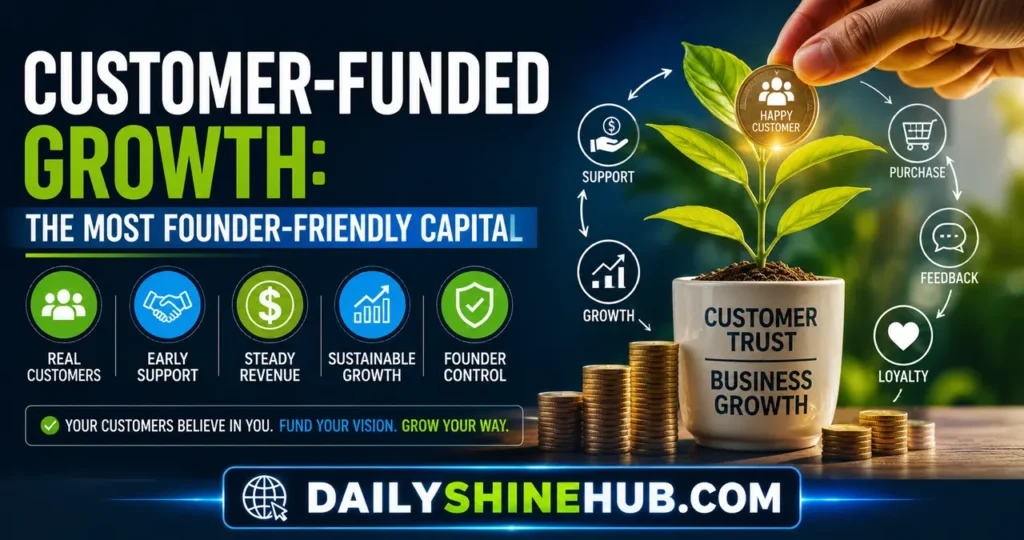
For many bootstrapped companies, the best source of funding is still the customer.
Pre-orders, annual contracts, deposits, subscriptions, retainers, and milestone-based payments can provide working capital without giving away ownership.
Consider a software company that normally charges customers monthly.
If it offers a discount for annual prepayment, it can bring future revenue forward.
That cash can then finance product development and hiring.
Similarly, a consulting or services company can negotiate deposits before beginning major projects.
Customer-funded growth works especially well when the product has strong demand and customers trust the company.
It also creates a valuable feedback loop.
The startup grows because customers are willing to finance its expansion—not because investors expect a particular growth trajectory.
Revenue-Based Financing for Predictable Revenue
Revenue-based financing can be attractive for startups with established recurring revenue.
Instead of selling equity, the business receives capital and repays it through an agreed percentage of future revenue until the financing obligation is satisfied.
This structure can allow founders to access growth capital while maintaining ownership.
However, it is not free money.
Founders must evaluate the total repayment amount, revenue-sharing percentage, repayment period, and impact on cash flow.
A financing structure that looks manageable during a strong month may become burdensome when revenue declines.
The central question is:
Can the business comfortably make payments while still funding operations and growth?
Small Angel Rounds Can Be Better Than Large VC Rounds
Sometimes equity financing is the right choice.
The mistake is assuming that every startup needs a large institutional venture round.
A bootstrapped founder may benefit from a smaller angel round that provides enough capital to reach the next valuation milestone.
For example, raising a modest amount from a few experienced investors may allow a startup to expand its team and increase revenue without immediately entering a larger institutional financing cycle.
The founder should focus on investors who bring more than money.
Relevant expertise, industry connections, hiring support, distribution relationships, and customer introductions can make a strategic angel investor far more valuable than a passive source of capital.
Strategic Investors: Capital Plus Leverage
Strategic investors can be particularly useful for bootstrapped companies.
A strategic investor might be:
- A company operating in an adjacent market.
- An industry executive.
- A distributor.
- A technology partner.
- A major customer.
- A supplier.
- An experienced entrepreneur.
The value of this type of investor can extend beyond the check.
Suppose a startup develops software for logistics companies.
An investment from an established logistics technology business could potentially provide distribution opportunities, partnerships, credibility, and industry knowledge.
However, strategic investment requires careful attention to conflicts of interest.
A founder should understand what information the investor receives and whether the investor could eventually influence partnerships, competitors, pricing, or strategic decisions.
Crowdfunding Can Expand Access to Capital
Crowdfunding provides another path for startups that have a compelling customer proposition.
Depending on the platform and legal structure, startups can raise money through rewards, pre-orders, or equity-based campaigns.
For consumer businesses, crowdfunding can offer an additional advantage: market validation.
A successful campaign can demonstrate that customers are willing to pay before a product reaches mass distribution.
However, crowdfunding is not passive fundraising.
It requires storytelling, marketing, community engagement, customer communication, and campaign preparation.
The founder should therefore treat the campaign itself as a marketing project.
Grants and Non-Dilutive Funding
Government programs, research grants, competitions, accelerators, and industry programs can sometimes provide non-dilutive capital.
This type of funding is especially valuable because the founder does not necessarily have to surrender ownership.
Grants are often highly competitive and may have specific eligibility requirements.
Some programs also restrict how funds can be used.
Nevertheless, founders should investigate them before selling equity.
A $250,000 grant can be significantly more founder-friendly than raising $250,000 by selling part of the company.
Negotiate the Terms, Not Just the Valuation

Founders frequently focus on valuation during fundraising.
Valuation matters, but it is only one part of the deal.
Control can also be affected by:
- Board seats.
- Voting rights.
- Protective provisions.
- Investor consent rights.
- Liquidation preferences.
- Anti-dilution provisions.
- Founder vesting.
- Drag-along provisions.
- Information rights.
- Future financing provisions.
A higher valuation with aggressive investor rights may ultimately be less attractive than a slightly lower valuation with founder-friendly governance.
The right question is not simply:
“How much is my company worth?”
It is:
“What am I giving up in exchange for this capital?”
Use Milestone-Based Fundraising
One of the strongest strategies for preserving ownership is raising capital in stages.
Instead of raising enough money to fund the company for several years, raise enough to reach the next meaningful milestone.
For example:
Stage 1: Raise enough to improve the product.
Stage 2: Demonstrate stronger revenue growth.
Stage 3: Raise additional capital at a higher valuation.
This strategy can reduce dilution because successful execution may increase the company’s value before the next financing round.
It also provides a natural checkpoint.
If the business does not perform as expected, the founder can reassess before accepting more outside capital.
Protect Founder Control Through Governance
Ownership structure should be designed deliberately.
Before signing a financing agreement, founders should understand who controls:
- The board.
- Major company decisions.
- Future fundraising.
- Acquisitions.
- Executive appointments.
- Issuance of new shares.
- Changes to company structure.
A founder-friendly governance structure can preserve decision-making authority even after bringing in outside shareholders.
Professional legal advice is especially important here.
Financing documents can contain complex provisions that have consequences far beyond the headline investment amount.
Create a Fundraising Story Around Discipline
Bootstrapped founders should not apologize for having avoided outside capital.
Bootstrapping can be positioned as evidence of discipline.
A strong fundraising narrative might sound like this:
“We built the company using customer revenue, validated demand, developed strong retention, and reached meaningful traction without relying on external capital. Now we’re raising a targeted amount to accelerate a proven growth engine.”
That story can be powerful because the founder is not asking investors to finance an untested concept.
The company already has evidence.
Capital is being used to accelerate something that works.
Know When Not to Raise Money
The smartest fundraising strategy may sometimes be not fundraising at all.
If a company is growing sustainably, generating healthy cash flow, and retaining customers, external capital may create more complexity than value.
Founders should consider raising money when capital can produce a measurable strategic advantage.
Examples include:
- A market window that requires rapid expansion.
- A technology investment competitors are making.
- A large contract requiring additional working capital.
- An opportunity to hire a critical team.
- International expansion.
- A distribution opportunity with a short deadline.
If the money simply increases the company’s bank balance without a clear use, fundraising may not be necessary.
Build a Founder-Friendly Capital Stack
There is no requirement to rely on one financing source.
A startup can combine several forms of capital.
For example:
Customer prepayments + retained earnings + small business financing + angel investment
may provide sufficient capital without requiring a large equity round.
Another startup might use:
Grants + revenue-based financing + customer contracts
to finance expansion while preserving ownership.
This blended approach can reduce dependence on any single capital provider.
Common Fundraising Mistakes Bootstrapped Founders Should Avoid
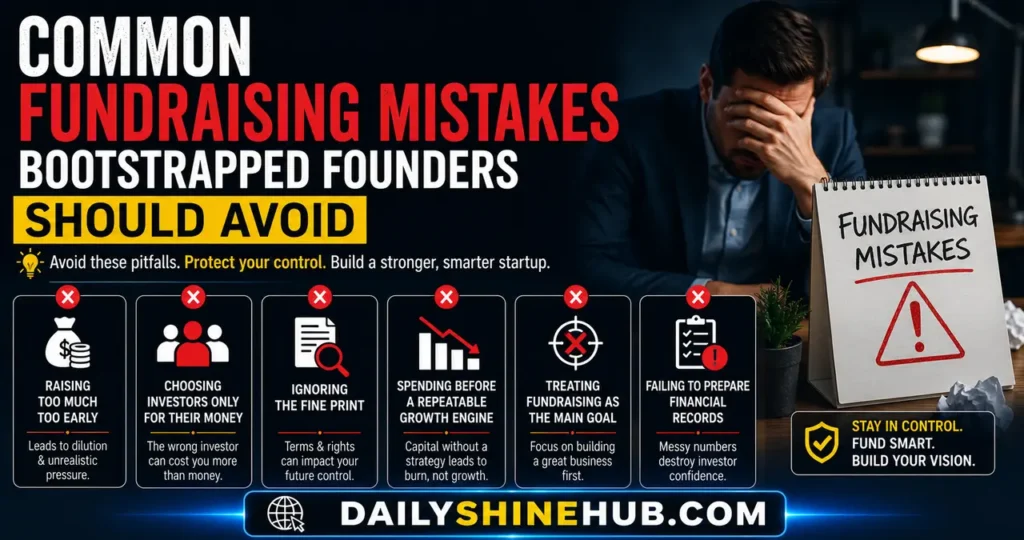
Raising Too Much Too Early
Large amounts of capital can create unnecessary dilution and unrealistic growth expectations.
Choosing Investors Only for Their Check Size
Money is important, but the wrong investor can create governance problems.
Ignoring the Fine Print
The headline valuation does not tell the whole story.
Spending Before Building a Repeatable Growth Engine
Capital can accelerate a good business, but it can also accelerate waste.
Treating Fundraising as the Main Goal
A successful financing round is not the same thing as a successful company.
Failing to Prepare Financial Records
Clean accounting, accurate metrics, realistic projections, and organized documentation increase investor confidence.
A Practical Roadmap for Founder-Controlled Fundraising
A bootstrapped startup can approach fundraising through a structured sequence.
Step 1: Establish Traction
Document revenue, customers, retention, margins, growth, and other relevant metrics.
Step 2: Define the Milestone
Decide exactly what additional capital will accomplish.
Step 3: Calculate the Minimum Raise
Avoid raising substantially more than necessary.
Step 4: Compare Financing Types
Evaluate customer funding, loans, grants, revenue-based financing, crowdfunding, angels, strategic investors, and venture capital.
Step 5: Determine Your Control Limits
Decide in advance how much equity and governance authority you are willing to give up.
Step 6: Build a Target Investor List
Prioritize investors whose experience aligns with the company’s market and objectives.
Step 7: Negotiate the Entire Deal
Evaluate valuation, ownership, governance, investor rights, liquidation preferences, and future financing implications.
Step 8: Tie Capital to Measurable Milestones
Use the money to create measurable improvements in revenue, customers, product capability, or operational efficiency.
Step 9: Reassess Before Raising Again
If the business reaches profitability or can finance further expansion internally, another round may not be necessary.
The Long-Term Advantage of Controlled Fundraising
The ultimate purpose of a startup booted fundraising strategy is not simply to obtain money.
It is to create a financing structure that supports sustainable growth while protecting the founder’s ability to make strategic decisions.
Bootstrapping gives entrepreneurs an important advantage: they can often wait for the right capital rather than accepting the first available offer.
That negotiating power should be protected.
A founder with customers, revenue, improving margins, and controlled expenses has more options than a founder who desperately needs money to survive the next month.
This is why disciplined financial management is part of fundraising strategy.
Every month of additional runway can improve negotiating leverage.
Every new customer can strengthen the investment story.
Every improvement in profitability can reduce dependence on outside capital.
Final Thoughts
A bootstrapped startup does not have to choose between growth and control.
With the right strategy, founders can raise capital selectively while protecting the ownership and independence that made the company attractive in the first place.
The strongest approach begins with understanding exactly why capital is needed.
From there, founders can compare non-dilutive funding, customer financing, revenue-based financing, strategic investment, angel capital, crowdfunding, and venture capital.
When equity is necessary, the goal should not simply be the highest possible valuation.
The better objective is a balanced deal that provides enough capital to reach the next milestone without unnecessarily surrendering ownership or governance authority.
Ultimately, smart fundraising is not about raising the most money—it is about raising enough money to build the company you actually want to own.
FAQs About Startup Booted Fundraising Strategy
1. Can a bootstrapped startup raise money without giving up equity?
Yes.
Bootstrapped startups can explore customer prepayments, business loans, revenue-based financing, grants, crowdfunding models, and other non-dilutive or less-dilutive options.
The most suitable choice depends on revenue predictability, cash flow, eligibility, and the company’s growth requirements.
2. How much should a bootstrapped startup raise?
The ideal amount depends on the company’s next measurable milestone.
Instead of raising the maximum amount available, founders should calculate the minimum capital required to reach a meaningful business objective while maintaining a reasonable cash reserve.
3. Is venture capital a bad choice for bootstrapped startups?
Not necessarily.
Venture capital can be valuable when a startup has a large market opportunity and needs substantial capital to scale quickly.
However, founders should understand that VC funding can involve dilution, governance requirements, board participation, and pressure for rapid growth.
4. What is the best funding option for maintaining founder control?
There is no universal answer, but customer-funded growth, grants, retained earnings, and certain forms of debt or revenue-based financing generally allow founders to retain more ownership than traditional equity financing.
The right choice depends on the company’s financial position and risk tolerance.
5. How can founders negotiate better fundraising terms?
Strong traction gives founders leverage.
Founders should know their financial metrics, define their control limits before negotiations, compare multiple financing options, evaluate the full investment agreement rather than only valuation, and seek qualified legal and financial advice before signing.
A founder who can demonstrate sustainable growth has a stronger position to choose capital rather than simply accept it.

Ethan Shine is a passionate content strategist, tech enthusiast, and digital media contributor at DailyShineHub. With over 5 years of experience in blogging and search engine optimization, Ethan specializes in breaking down complex topics into clear, actionable insights. When he isn’t researching the latest industry trends, he enjoys exploring global news, digital tools, and modern lifestyle concepts.