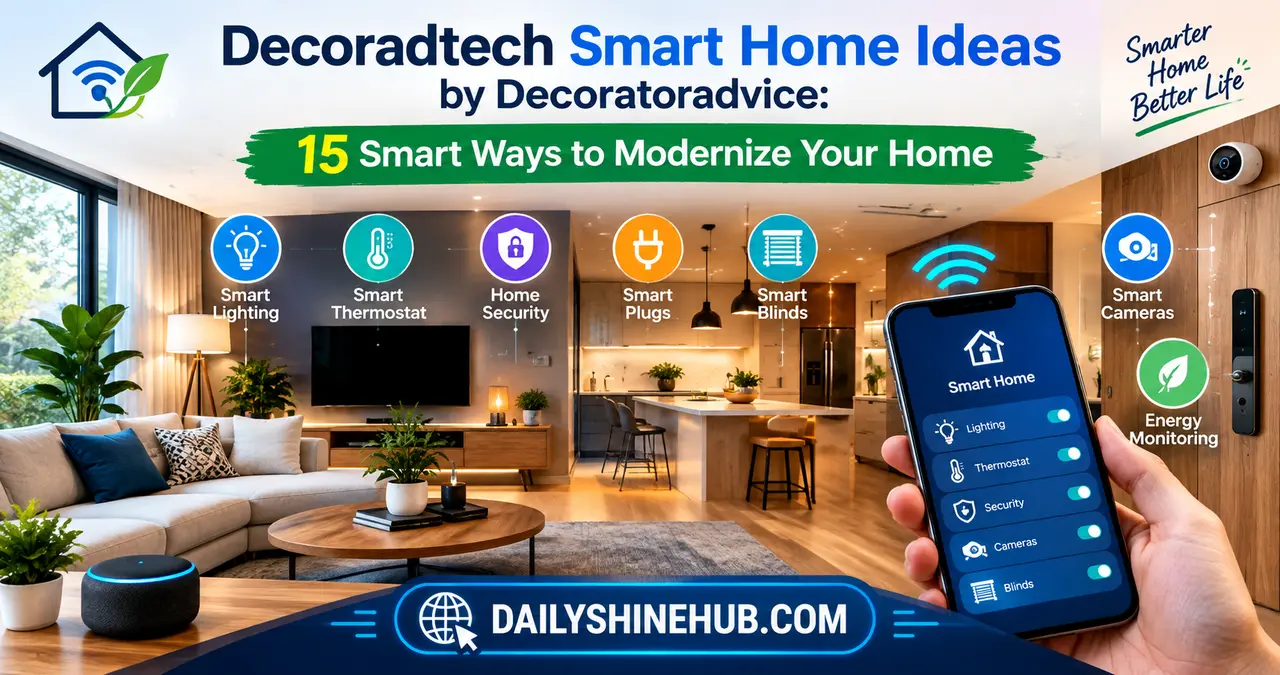
Modern home improvement is no longer limited to repainting walls, replacing furniture, or upgrading kitchen cabinets. Technology has become an important part of how people design comfortable, efficient, secure, and convenient living spaces. Decoradtech Smart Home Ideas by Decoratoradvice bring together interior design thinking and connected-home technology to create spaces that look attractive while also working intelligently.
A smart home can be as simple as installing automated lights or as advanced as connecting lighting, climate control, security, appliances, and energy monitoring into one coordinated system. The goal is not to fill every room with gadgets. Instead, thoughtful automation should solve everyday problems and make the home easier to manage.
Quick Overview of Decoradtech Smart Home Ideas by Decoratoradvice
| Feature | Main Purpose | Ideal For | Difficulty |
|---|---|---|---|
| Smart Lighting | Automated illumination | Bedrooms, living rooms, kitchens | Easy |
| Smart Thermostat | Climate management | Whole home | Easy–Moderate |
| Smart Locks | Keyless access | Entry doors | Moderate |
| Security Cameras | Home monitoring | Exterior and entry points | Moderate |
| Smart Plugs | Appliance control | Small appliances | Easy |
| Motion Sensors | Automatic actions | Hallways, bathrooms | Easy |
| Smart Blinds | Light and privacy control | Bedrooms, living areas | Moderate |
| Energy Monitoring | Track electricity use | Whole home | Moderate |
| Voice Control | Hands-free operation | Connected devices | Easy |
| Smart Hub | Centralized automation | Larger smart homes | Moderate |
What Makes Decoradtech Smart Home Ideas by Decoratoradvice Useful?
The strongest approach to smart-home design combines technology with practical interior planning. A connected device should have a clear purpose instead of becoming another piece of electronic clutter.
Some of the most useful principles include:
- Choose technology that solves a genuine household problem.
- Consider the room’s existing design before adding devices.
- Prioritize reliability over the number of features.
- Select products that can communicate through compatible platforms.
- Think about privacy and cybersecurity before connecting cameras or sensors.
- Plan for future upgrades rather than installing everything at once.
This approach makes smart technology feel like part of the home instead of something added afterward.
Decoradtech Smart Home Ideas by Decoratoradvice for Smart Lighting
Lighting is one of the easiest areas to improve because smart bulbs, switches, dimmers, and motion sensors can dramatically change how a room feels.
Instead of turning every light on manually, homeowners can create different lighting scenes for different activities.
1. Create Room-Specific Lighting Scenes
A living room might have separate settings for watching television, reading, entertaining guests, and relaxing at night.
Useful scenes include:
- Morning: Bright, cool-toned lighting.
- Evening: Softer illumination for relaxation.
- Movie Mode: Reduced ambient lighting.
- Reading Mode: Focused light near seating.
- Night Mode: Low-level pathway lighting.
This is particularly useful in open-plan homes where one lighting arrangement may not work for every activity.
2. Add Motion-Activated Lighting
Motion sensors can automatically turn lights on when someone enters a space. They are particularly practical for:
- Hallways
- Staircases
- Bathrooms
- Garages
- Closets
- Entryways
For example, low-level lighting can activate when someone walks toward the bathroom during the night, reducing the need to search for a wall switch.
Decoradtech Smart Home Ideas by Decoratoradvice for Better Home Security
Security technology has become another major part of modern home improvement. Smart locks, doorbell cameras, window sensors, and outdoor cameras can provide homeowners with additional visibility around their property.
A practical smart security setup can include:
- A video doorbell at the main entrance.
- Motion-sensitive exterior lighting.
- Door and window contact sensors.
- Smart locks with individual access codes.
- Security cameras covering important exterior areas.
- Smartphone notifications for selected events.
However, connected security devices should be configured carefully. The U.S. Department of Energy notes that interconnected smart systems create cybersecurity considerations and potential security gaps when they are not designed and managed appropriately.
For that reason, homeowners should use strong, unique passwords, enable available security protections, update device firmware, and avoid unnecessary public access to cameras.
Smart Thermostats and Climate Control
Temperature management is one of the most practical applications of smart-home technology. A smart thermostat can use schedules, occupancy information, and other inputs to help manage heating and cooling.
According to the U.S. Department of Energy, smart thermostats are among the smart-home technologies that have demonstrated energy-saving potential, although performance can depend on the HVAC system and how the thermostat is used.
Before purchasing one, consider:
- Whether it supports your HVAC equipment.
- Whether you need remote smartphone control.
- Whether occupancy detection is useful for your household.
- Whether the device supports scheduling.
- Whether professional installation is necessary.
A thermostat should complement the home’s existing heating and cooling system rather than simply being selected because it has the most features.
Smart Plugs for Simple Automation
Smart plugs are among the easiest entry points into home automation. They can add remote or scheduled control to compatible appliances without requiring an entirely new smart appliance.
Common applications include:
- Lamps
- Fans
- Coffee makers
- Decorative lighting
- Chargers
- Small kitchen appliances
A smart plug can also help reduce unnecessary standby operation when used appropriately. The Department of Energy highlights advanced power strips, wireless meters, and controls as ways to manage plug loads.
Always check the plug’s electrical rating before connecting an appliance, particularly equipment that produces substantial heat or draws significant power.
Smart Blinds for Comfort and Privacy
Window coverings are sometimes overlooked in smart-home planning, but automated blinds can contribute to both convenience and interior design.
Motorized blinds can be scheduled to:
- Open gradually in the morning.
- Close during the brightest part of the afternoon.
- Provide privacy after sunset.
- Coordinate with lighting scenes.
- Reduce unwanted glare on television or computer screens.
They can also create a cleaner visual appearance because there are fewer cords and manual controls around windows.
Energy Monitoring as a Home Improvement Tool
Smart-home technology becomes more useful when homeowners can understand how their property consumes energy. Energy monitors can provide information about electricity usage and help identify patterns that might otherwise go unnoticed.
Useful energy-management ideas include:
- Monitor unusually high electricity consumption.
- Track major appliances.
- Identify devices that remain active unnecessarily.
- Compare usage at different times of day.
- Combine monitoring with automated controls.
The Department of Energy’s current home-upgrade resources also recognize smart technology and programmable controls as potential components of energy-saving home improvements.
Energy monitoring does not automatically reduce consumption. The real benefit comes from using the information to make practical changes.
Smart Kitchen Ideas for a More Efficient Home
The kitchen is another excellent place to introduce connected technology, particularly when functionality is more important than novelty.
Consider:
- Smart appliance scheduling.
- Under-cabinet smart lighting.
- Motion-activated pantry lights.
- Smart plugs for selected countertop devices.
- Water-leak sensors beneath sinks.
- Smart exhaust or ventilation controls where compatible.
The best kitchen automation should remain easy to use. If a system requires complicated commands for simple tasks, it may create more frustration than convenience.
Smart Bathroom Improvements
Bathrooms can benefit from relatively simple automation without becoming overly technical.
Ideas include:
- Motion-activated night lighting.
- Humidity sensors.
- Automated ventilation.
- Water-leak detection.
- Smart mirrors with integrated lighting.
- Timed towel or floor-heating controls where appropriate.
Moisture-sensitive devices should always be selected and installed according to manufacturer safety requirements.
Voice Control and Smart Home Hubs
Voice assistants and smart hubs can bring different devices together. Instead of controlling every product through a separate application, compatible devices may be managed through a centralized interface.
For example, a single routine could potentially:
- Dim the living-room lights.
- Adjust the thermostat.
- Close compatible blinds.
- Lock connected doors.
- Turn off selected smart plugs.
The important word is compatible. Not every device works with every platform, so compatibility should be checked before purchasing multiple products.
Designing Smart Technology Without Ruining Your Interior
Technology should support the visual character of a home rather than dominate it.
Try these design principles:
- Hide unnecessary cables.
- Use recessed or discreet sensors when possible.
- Choose finishes that complement existing hardware.
- Keep visible screens to a minimum.
- Mount cameras carefully rather than placing them randomly.
- Use smart switches that match the home’s overall aesthetic.
- Keep hubs and routers in practical but ventilated locations.
Good smart-home design is often less about showing technology and more about making technology almost invisible.
How to Start With Decoradtech Smart Home Ideas by Decoratoradvice
You do not need to automate an entire property in one weekend. A gradual strategy can be more affordable and easier to manage.
Step 1: Identify Everyday Problems
Write down tasks you repeat frequently.
Examples include:
- Forgetting to switch off lights.
- Adjusting the thermostat repeatedly.
- Checking whether doors are locked.
- Managing outdoor lighting.
- Monitoring energy consumption.
Step 2: Choose One Smart-Home Category
Start with lighting, security, climate, or energy monitoring rather than buying unrelated products.
Step 3: Check Compatibility
Before purchasing, verify that the device works with your preferred smart-home ecosystem.
Step 4: Build Simple Automations
Start with basic routines rather than complicated sequences.
Step 5: Review the Results
After several weeks, determine whether the technology is actually making the home easier to operate.
If it is not solving a real problem, there may be little reason to expand the system.
Budget-Friendly Smart Home Improvements
Smart-home upgrades do not always require expensive equipment. Some of the most useful changes can be relatively inexpensive.
A starter setup could include:
- Two or three smart bulbs.
- One or two smart plugs.
- A basic motion sensor.
- A compatible smart speaker or hub.
- A programmable or smart thermostat if appropriate.
Once these devices are working reliably, homeowners can consider larger improvements such as smart locks, security cameras, automated blinds, energy monitoring, or connected appliances.
Common Mistakes to Avoid
Smart technology can create problems when it is purchased without planning.
Avoid these mistakes:
- Buying devices without checking compatibility.
- Installing too many different ecosystems.
- Ignoring software updates.
- Using weak or reused passwords.
- Installing cameras without considering privacy.
- Automating tasks that are faster to do manually.
- Choosing products based entirely on flashy features.
- Forgetting about network reliability.
A smart home should simplify daily life. If it becomes difficult to maintain, troubleshoot, or understand, the technology has defeated its main purpose.
Future Trends in Smart Home Improvement
Smart-home technology is increasingly moving toward systems that coordinate devices rather than simply controlling individual gadgets. Smart panels, energy-management systems, occupancy sensors, connected appliances, and automated controls are all part of this broader direction.
The Department of Energy is researching smart controls and home energy-management systems that can coordinate electricity use and interact with technologies such as solar generation and battery storage.
Future systems are likely to place greater emphasis on:
- Energy optimization.
- Automated climate management.
- Home resilience.
- Device interoperability.
- Occupancy-based automation.
- Improved cybersecurity.
- More efficient appliances.
- Centralized energy management.
The result could be homes where automation happens quietly in the background rather than requiring constant interaction.
Conclusion
Decoradtech Smart Home Ideas by Decoratoradvice demonstrate how technology and interior-focused home improvement can work together without making a property feel overly complicated. Smart lighting, thermostats, security devices, sensors, smart plugs, automated blinds, and energy-monitoring systems can each serve a practical purpose when selected carefully.
The most successful smart home is not necessarily the one with the greatest number of connected devices. It is the one where technology improves comfort, convenience, security, efficiency, or accessibility while fitting naturally into the home’s design. Start with one genuine household need, select compatible technology, and expand gradually as your system proves useful.
Related: Read our detailed guide on smart home improvement and modern home technology ideas
FAQs
1. What are Decoradtech Smart Home Ideas by Decoratoradvice?
Decoradtech Smart Home Ideas by Decoratoradvice refer to practical concepts that combine home decorating and improvement with smart technology. Examples include automated lighting, smart thermostats, security systems, sensors, smart plugs, and connected appliances.
2. What is the easiest smart-home upgrade for beginners?
Smart lighting and smart plugs are generally straightforward starting points because they can add automation without requiring major changes to the home’s electrical or structural systems.
3. Can smart-home technology help reduce energy use?
Some technologies can help manage energy consumption, particularly smart thermostats and systems that provide better visibility or control over household energy use. Results depend on the equipment, configuration, household behavior, and local conditions.
4. Are smart security devices safe to use?
Smart cameras, locks, and sensors can be useful, but they should be configured securely. Strong passwords, software updates, appropriate privacy settings, and secure network practices are important for connected devices.
5. Should I automate my entire home at once?
Not necessarily. A gradual approach is often easier to manage. Start with one category, such as lighting or climate control, evaluate how useful it is, and then expand the system with compatible devices.
DailyShineHUb

Ethan Shine is a passionate content strategist, tech enthusiast, and digital media contributor at DailyShineHub. With over 5 years of experience in blogging and search engine optimization, Ethan specializes in breaking down complex topics into clear, actionable insights. When he isn’t researching the latest industry trends, he enjoys exploring global news, digital tools, and modern lifestyle concepts.