

Buying a new or used Subaru is an exciting experience, but for many customers, the most important part of the journey begins after choosing the vehicle: understanding how Subaru finance works. The dealership financing process involves more than simply signing paperwork. It includes evaluating your credit profile, selecting the right loan or lease option, preparing documents, negotiating terms, and completing the final approval process. For Subaru buyers comparing different vehicle funding options, understanding broader auto finance concepts can make the process easier to navigate.
Subaru dealerships work with customers from a wide range of financial backgrounds, including first-time buyers, experienced vehicle owners, customers rebuilding credit, and buyers looking for competitive loan rates. The finance application process is designed to connect customers with suitable payment solutions while helping dealerships complete vehicle sales efficiently. Whether you are interested in a Subaru Outback, Forester, Crosstrek, Ascent, Impreza, or another model, understanding the financing steps can help you prepare before visiting the dealership.
This guide explains the Subaru finance dealership process, how credit applications work, what lenders consider during approval, how to improve your chances of acceptance, and what questions to ask before signing a financing agreement.
Understanding Subaru Finance Options at the Dealership
When customers visit a Subaru dealership, the finance department plays a major role in completing the vehicle purchase. After selecting a Subaru model and negotiating the vehicle price, buyers usually meet with a finance specialist who reviews available payment options.
Subaru finance options generally include traditional auto loans, lease agreements, and manufacturer-supported financing programs. The best option depends on your budget, driving habits, credit score, ownership goals, and preferred monthly payment.
A dealership finance professional typically evaluates:
- Vehicle purchase price
- Down payment amount
- Trade-in value
- Credit history
- Income information
- Loan term preferences
- Available incentives
The goal is to create a financing structure that fits the customer’s financial situation while meeting lender requirements.
The Role of the Subaru Dealership Finance Department
Many buyers assume the dealership finance office only handles paperwork, but it performs several important functions during the purchase process. The finance department acts as a connection between the customer and financial institutions that provide auto loans.
A Subaru dealership finance manager may:
- Submit credit applications to multiple lenders
- Explain available financing programs
- Review interest rate options
- Discuss warranties and protection products
- Prepare legal purchase documents
- Complete registration and title paperwork
The finance department helps simplify the buying process by managing communication between the buyer, dealership, and lenders.
How the Subaru Credit Application Process Works
The Subaru finance application process usually begins after the customer selects a vehicle. Some dealerships allow buyers to complete an online credit application before visiting the showroom, while others handle the process in person.
Step 1: Selecting Your Subaru Vehicle
Before applying for financing, buyers usually choose the vehicle they want to purchase. The selected model, trim level, mileage (for used vehicles), and purchase price influence the final loan amount.
For example, financing a new Subaru Outback with advanced features may require a different budget compared with purchasing a pre-owned Subaru Impreza.
Understanding your preferred vehicle price range helps you estimate monthly payments before submitting a credit application.
Step 2: Completing the Credit Application
The credit application collects financial information that lenders use to evaluate loan eligibility.
A typical Subaru finance application requires:
| Application Requirement | Why It Matters |
|---|---|
| Full legal name and contact details | Identifies the applicant and verifies personal information |
| Social Security number or identification details | Allows lenders to check credit history |
| Employment information | Helps confirm income stability |
| Monthly income details | Determines repayment ability |
| Housing information | Helps evaluate financial obligations |
| Vehicle information | Determines financing amount |
Providing accurate information is essential because incorrect details can delay approval.
Step 3: Credit Review and Lender Evaluation
After submitting the application, the dealership sends the information to financial institutions. Lenders review several factors before approving financing.
Common factors include:
- Credit score
- Payment history
- Debt-to-income ratio
- Employment stability
- Previous auto loan experience
- Loan amount requested
A higher credit score often provides access to better interest rates, but customers with average or limited credit may still qualify through specialized lending programs.
What Credit Score Is Needed for Subaru Finance?
There is no single credit score requirement that guarantees Subaru finance approval. Different lenders have different standards, and approval depends on the entire financial profile.
Generally:
- Excellent credit customers may qualify for lower interest rates and promotional offers.
- Good credit customers often receive competitive financing terms.
- Fair credit customers may receive approval with adjusted rates.
- Lower credit applicants may need a larger down payment or additional documentation.
Customers should avoid focusing only on their credit score. Income, employment history, debt levels, and loan size also influence lender decisions.
Preparing Your Credit Before Applying for Subaru Financing
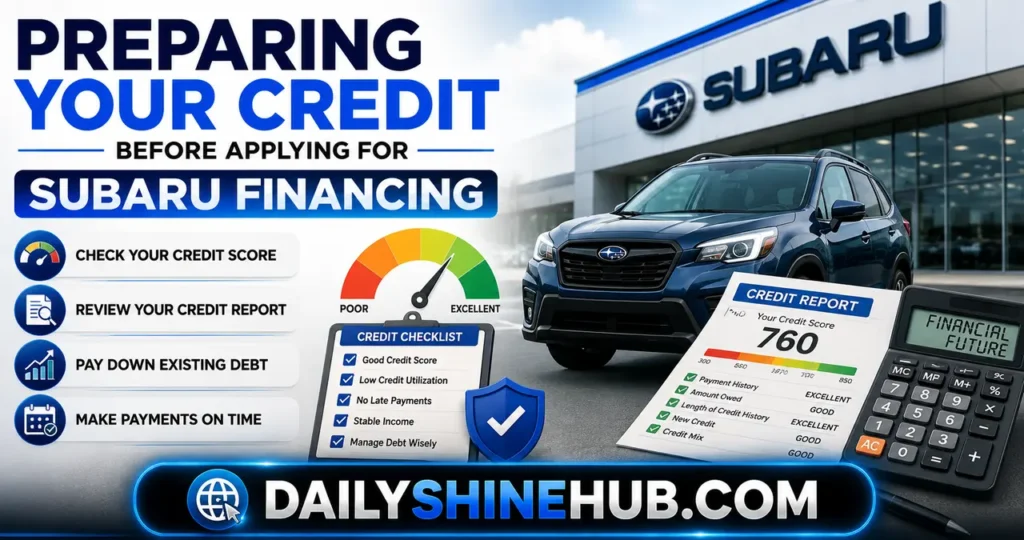
A little preparation before visiting the dealership can improve your financing experience. Checking your credit report before applying allows you to identify possible errors or outdated information, while reducing existing debt may strengthen your overall financial profile. Buyers should also consider saving for a down payment and organizing documents such as proof of income, residence, insurance, and trade-in information. For broader guidance on how professional financial planning can support major purchasing decisions, readers may also explore this business consulting resource.
Review Your Credit Report
Checking your credit report before applying allows you to identify possible errors or outdated information. Correcting mistakes early may improve your credit profile.
Reduce Existing Debt
Lenders often examine your debt-to-income ratio. Paying down credit cards or other loans may strengthen your application.
Save for a Down Payment
A larger down payment can reduce the amount financed, lower monthly payments, and demonstrate financial responsibility to lenders.
Organize Financial Documents
Having documents ready can speed up the approval process.
Common documents include:
- Driver’s license
- Proof of income
- Proof of residence
- Insurance information
- Trade-in vehicle documents
Subaru Loan vs. Subaru Lease: Choosing the Right Option
One of the biggest decisions during the dealership finance process is whether to purchase through a loan or choose a lease.
Financing a Subaru Purchase
A traditional auto loan allows you to own the vehicle after completing payments. This option is popular among buyers who plan to keep their Subaru for many years.
Benefits include:
- Long-term ownership
- No mileage restrictions
- Ability to build vehicle equity
- Freedom to customize the vehicle
However, monthly payments may be higher compared with leasing because you are paying for the entire vehicle cost.
Leasing a Subaru
Leasing allows customers to drive a new Subaru for a specific period, usually with lower monthly payments compared with traditional financing.
Benefits include:
- Lower monthly payments
- Regular access to newer models
- Warranty coverage during the lease period
- Lower upfront costs
However, leases typically include mileage limits and do not provide ownership unless the vehicle is purchased at the end of the agreement.
Understanding Subaru Finance Interest Rates
Interest rates significantly affect the total cost of a vehicle. Even a small difference in the annual percentage rate (APR) can change monthly payments and the overall amount paid.
Factors affecting Subaru finance rates include:
- Credit score
- Loan term length
- Market conditions
- Vehicle age
- Loan amount
- Down payment
Customers should compare different financing terms instead of focusing only on monthly payment amounts.
A lower monthly payment may sometimes result from extending the loan term, which can increase the total interest paid over time.
Negotiating Subaru Finance Terms at the Dealership
Many buyers negotiate the vehicle price but forget that financing terms can also be discussed.
Important areas to review include:
Loan Length
Common auto loan terms range from shorter periods with higher payments to longer periods with lower payments.
Interest Rate
Ask whether the offered rate is competitive based on your credit profile.
Additional Products
Dealership finance departments may offer optional products such as:
- Extended service contracts
- Maintenance plans
- Vehicle protection packages
- GAP coverage
These products may be useful for some buyers, but customers should understand costs and benefits before accepting them.
Online Subaru Finance Applications: A Faster Buying Approach
Many Subaru dealerships now allow customers to begin financing online. This option helps buyers estimate affordability before entering the showroom. Online financing may allow customers to submit credit applications, estimate monthly payments, value trade-in vehicles, review available inventory, and schedule dealership appointments. As dealerships increasingly adopt digital tools to streamline sales and customer interactions, broader developments in sales technology are also influencing how consumers and businesses manage modern purchasing processes.
Online financing may allow customers to:
- Submit credit applications
- Estimate monthly payments
- Value trade-in vehicles
- Review available inventory
- Schedule dealership appointments
Completing preliminary steps online can reduce dealership waiting time and make the final purchase process more convenient.
Common Mistakes Customers Make During Subaru Financing
Even prepared buyers can make mistakes during the financing process. Customers should avoid focusing only on monthly payments, skipping loan comparisons, adding unnecessary costs, or failing to read the final contract carefully. It is also important to review any digital or electronic documents before agreeing to terms. As financial transactions become increasingly connected to online systems, businesses are paying greater attention to digital security and customer data protection, an issue explored further in resources covering cybersecurity services for businesses.
Focusing Only on Monthly Payments
A lower monthly payment does not always mean a better deal. Always consider the total loan cost.
Not Checking Credit Before Applying
Unexpected credit issues can affect financing options.
Skipping Loan Comparisons
Customers may accept the first offer without comparing alternatives.
Adding Unnecessary Costs
Review every optional product and fee before signing documents.
Not Reading the Contract Carefully
The final agreement should match the terms you discussed with the dealership.
How Trade-Ins Affect Subaru Finance Applications

Many Subaru buyers use an existing vehicle as a trade-in. A trade-in can reduce the amount needed for financing and may improve affordability.
The dealership typically evaluates:
- Vehicle condition
- Mileage
- Market value
- Remaining loan balance
If your trade-in has positive equity, that value can often be applied toward the Subaru purchase.
Tips for a Successful Subaru Dealership Finance Experience
To make the financing process easier:
- Research Subaru models and prices before visiting the dealership.
- Check your credit score and financial situation.
- Determine a comfortable monthly budget.
- Bring necessary documents.
- Compare financing offers.
- Ask questions about every fee and agreement term.
- Avoid rushing into a decision.
A prepared customer is more likely to secure financing terms that match their needs.
Final Thoughts on Subaru Finance and Credit Applications
The Subaru finance process is designed to help customers purchase vehicles through structured payment solutions. Understanding how dealership financing works gives buyers more confidence when applying for credit, reviewing loan offers, and completing paperwork.
From the initial credit application to final contract signing, every step matters. Customers who prepare their finances, understand lending factors, and carefully review available options can make smarter decisions and enjoy a smoother Subaru ownership experience.
For additional context on how connected technology is changing everyday products and services, readers can explore Gizmo and Gadgets.
Whether you are purchasing your first Subaru or upgrading to a newer model, learning the dealership finance process helps you approach the transaction with greater knowledge and control.
FAQs About Subaru Finance Dealership & Credit Application Process
1. Can I apply for Subaru finance before visiting the dealership?
Yes. Many Subaru dealerships allow customers to complete an online finance application before arriving. This can help speed up the approval process and provide an estimate of available financing options.
2. What information do I need for a Subaru credit application?
You typically need personal identification details, employment information, income details, housing information, and vehicle purchase information to complete a Subaru finance application.
3. Can I get Subaru financing with average or poor credit?
Yes, approval may still be possible with less-than-perfect credit. Lenders may consider other factors such as income, employment stability, down payment amount, and debt levels.
4. Should I finance a Subaru through the dealership or my bank?
Both options can work. Dealership financing may provide access to manufacturer programs and multiple lenders, while banks or credit unions may offer competitive rates. Comparing options is recommended.
5. How long does the Subaru finance approval process take?
The approval timeline varies depending on lender response, application accuracy, and financial complexity. Many customers receive decisions quickly when documents are complete and information is accurate.

Ethan Shine is a passionate content strategist, tech enthusiast, and digital media contributor at DailyShineHub. With over 5 years of experience in blogging and search engine optimization, Ethan specializes in breaking down complex topics into clear, actionable insights. When he isn’t researching the latest industry trends, he enjoys exploring global news, digital tools, and modern lifestyle concepts.